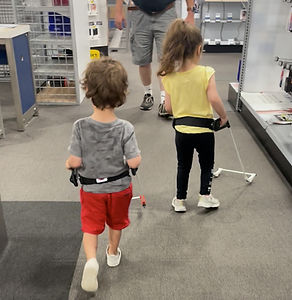
CANE FRAME FIRST
A cane frame bump is better than a body bump.
Children with a mobility visual impairment or blindness deserve mobility tools that make their next step clear, protect their bodies, and let them move with obvious, proud confidence. Pediatric and Big-kid Belt Canes give children a cane frame that reaches the world before their body does—and gives families something to stand behind with pride.
Wear the cane frame with pride.
The Simple Idea
When a child with a mobility visual impairment or blindness (MVI/B) moves through the world, the first contact should not have to be the MVI/B child’s forehead, chest, hands, knees, or toes. The first contact should be the mobility tool. That is why the cane frame matters.
A Pediatric or Big-kid Belt Cane surrounds the child with a lightweight cane frame that gives immediate tactile feedback and helps maintain about 1.5 feet of personal space—the typical close social distance people use in everyday interaction. When their way is clear, the child with an MVI/B can keep moving. When their way is blocked, the cane frame stops first. The feedback is honest. The next step becomes clearer. The child’s body is no longer the bumper.
For the child with an MVI/B, the Belt Cane becomes a badge of self-reliance: “I am able to locate the clear path all by myself.”
For the family, it can become a badge of advocacy: “We are proud to give our child with an MVI/B the tools that make movement safer, clearer, and more independent.”

Why This Campaign Exists
We need sighted people to become accustomed to blind children having the mobility tools they need. These bright white cane frames are obvious and claim the space in front of the child for their next step.
A visible mobility tool is not something to hide, apologize for, or make smaller so adults feel more comfortable. White cane frames are access, safety. The Belt Cane is a blind child's independence made visible.
A Belt Cane is a badge of honor for the child with an MVI/B and the family: a sign that this blind child’s movement matters enough to protect, support, and celebrate.
When sighted people learn to expect and welcome Belt Canes, children with an MVI/B get more room to move, explore, and participate without the world treating their access as unusual.
What Wearing the Belt Cane Makes Possible for an MVI/B Child
-
Protected personal space: The cane frame helps preserve about 1.5 feet of personal space around the MVI/B child, making it clearer to others where the child’s body and movement space begin.
-
Full next-step confidence: The child with an MVI/B receives tactile information before stepping into uncertainty.
-
Honest touch feedback: If the path is blocked, the frame communicates that clearly.
-
Less body-first contact: The frame can meet the obstacle before the MVI/B child’s body does.
-
More obvious access: The tool is visible so people can see it, notice it, and make space for it.
-
More independent movement: Children with an MVI/B can explore with less adult prompting and less hesitation.
Watch the Proof
This campaign is built on real footage of children with an MVI/B before and while wearing Pediatric and Big-kid Belt Canes. Again and again, the videos show the same pattern: the frame reaches first, the child with an MVI/B receives clearer feedback, and movement improves.

Before the Belt Cane / With the Belt Cane
Compare obvious outcomes
No Cane Frame
Child's body is unprotected
The child with an MVI/B may slow down, guard the body, wait for adult direction, or bump body-first into what the blind child cannot see.
Adults Hover
The blind child collides
Adults may hover, prompt, steer, warn, or stop the child because the surroundings feel uncertain.
The world teaches hesitation when the child’s body is the first detector.
Cane Frame
Reaches obstacles first
The frame reaches first, gives immediate tactile feedback, and helps the child decide whether the next step is clear.
Adults Teach
The cane frame collides
The blind child receives information directly through the cane frame, movement less dependent on adults.
The child learns confidence because the cane frame stops them before the body bump happens.
What We Want Sighted People to Understand
• If you notice the Belt Cane, it is doing part of its job.
• Do not shrink the tool in your mind. Make room for it in the world.
• Do not treat a blind child’s visible mobility tool as sad, strange, or excessive.
• The child with an MVI/B does not need to make access less obvious so adults feel more comfortable.
• For the blind child and family, the Pediatric and Big-kid Belt Cane can be worn and shared with pride.
• Obvious tools help create obvious access.

For Parents, Educators, and Professionals
If a child with an MVI/B needs full next-step confidence, ask whether the MVI/B child has a mobility tool that gives direct, protective, honest feedback before the body makes contact.
Long canes can be important tools, but children born with an MVI/B find cane frames more easily protects their body, reaches obstacles first, and supports movement long before they cane learn complex long-cane techniques.
The question is not: “How can we make this tool less noticeable?”
The better question is: “How can we make sure children with an MVI/B have the clearest, safest next step?”
Join the Campaign
Help improve public acceptance of blind children moving with highly visible and intrusive mobility tools. Share the videos. Send this page to a parent, teacher, therapist, doctor, early intervention provider, school administrator, or family member. Start a conversation about why a cane frame bump is better than a body bump.