


Self-reliant Movement is possible when Blind Children wear Belt Canes
The Pediatric Belt Cane design enables children with a mobility visual impairment or blindness to feel what's ahead before they take their next step. The cane frame extends into the path to fill in the blanks caused by the child's vision impairment or blindness (MVI/B), with sensory feedback.
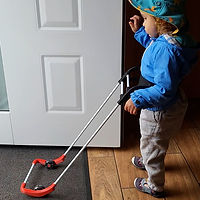
Child wears Belt Cane during recommended hours of daily activity
Child feels secure, their body feels balanced, protected and they feel informed by the mobility frame.

Cane frame protects and improves obstacle awareness
Child feels what's ahead just beyond their arm's reach for safer informed contact to aid their spatial awareness.
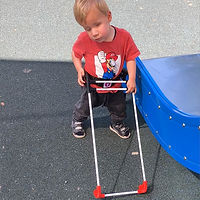
Safer movement becomes more independent
Child feels their path through the world is predictable allowing confidence in their self-reliance to grow.
What Is Extended Touch Feedback?
Extended touch feedback is using a cane to gather information beyond arm's reach.
Why does this matter?
With extended touch feedback blind children can more easily:
-
Anticipate changes: Feel information about steps, obstacles, and changes in surface height or texture before reaching them.
-
Develop protective responses: Use their hands and bodies to respond to environmental information and maintain balance.
-
Explore more independently: Gain opportunities to move, investigate, and practice new motor skills with greater awareness of their surroundings.
-
Build confidence through experience: Learn about their environment through active movement rather than relying solely on an adult to guide them.

Clinical Justification
A mobility visual impairment or blindness (MVI/B) impairs visual access to environmental information needed for safe, independent movement.
Without a way to preview what lies ahead, movement can become less predictable. A child may have difficulty detecting obstacles, steps, changes in surface height or texture, and other environmental transitions before reaching them. This can increase reliance on adult guidance and reduce opportunities for independent exploration and movement practice.
Extended touch feedback provides another way to access this information. By bringing tactile information from the environment within the child’s reach before their body reaches it, extended touch can support:
-
Anticipation of obstacles, steps, and changes in the walking surface
-
Motor planning and preparation for environmental changes
-
Balance and protective responses during movement
-
Orientation within open and changing environments
-
Active exploration and movement practice
The goal is not simply to detect obstacles. It is to give children with an MVI/B access to information they need to move, explore, learn, and develop self-reliant mobility.
Value for Schools and Insurance This 3-year Growth Kit subscription program seamlessly maintains a custom-sized mobility device as the child develops, without requiring school districts or insurance providers to process entirely new purchase orders every year.


Documents Center
Download guides, templates, and supporting documentation for families, educators, therapists, and funding teams.


Clinical considerations in mobility for children with visual Impairment
Visual impairment can significantly affect a child’s ability to gather consistent environmental information needed for safe, independent movement.
Children who are blind or have a mobility visual impairment may have difficulty consistently detecting and interpreting visual information needed for safe navigation.
This can affect their ability to anticipate obstacles, changes in terrain, or environmental transitions in time to adjust movement.
For example, environmental changes such as moving from low light to bright light, or from indoor to outdoor spaces, may temporarily reduce visual orientation and increase reliance on non-visual feedback.
As a result, independent movement can become less predictable and more dependent on adult supervision or environmental familiarity.
Walking Challenges for Children with a Mobility Visual Impairment or Blindness


MVI/B impact on early walking
Movement develops through the integration of sensory feedback and motor experience. For children with a mobility visual impairment or blindness (MVI/B), extended touch can be used to fill in the blanks.
Sensorimotor development refers to the coordination of sensory input and motor actions that support learning through movement.
Children have an MVI when their visual input is too unreliable to support spatial awareness, safety, and balance. MVI/B are the same result: the inability to use vision for safe travel.
As a result, children with an MVI/B can learn to rely on other sensory information (e.g., touch and sound) to understand their environment and guide movement.
Consistent extended touch feedback can support this process by protecting the space ahead and providing the child with stable, immediate information about that space ahead of them.
This information contributes to their balance, orientation, and movement planning.


Recommended Daily Physical Activity and early mobility
Physical activity in early childhood supports motor, cognitive, and social development. Independent movement plays an important role in achieving daily activity levels.
Young children between ages 1–4 require regular physical activity to support healthy motor and cognitive development.
In typical development, increasing mobility allows children to explore their environment more independently, which contributes to higher levels of daily movement and engagement.
Children who are blind or have a mobility-related visual impairment may experience barriers to independent movement depending on the availability of support, environment, and assistive tools.
When movement relies heavily on hand-holding, strollers, or restricted guidance, opportunities for self-initiated physical activity may be reduced.

Wearable Belt Cane Evidence Base
1. Clinical outcomes and gait/mobility studies
Chong P, Brown AD, Enzenauer RW, Ambrose-Zaken G. The Role of a Pediatric Belt Cane in Children with Cerebral Visual Impairment. Clin Ophthalmol. 2026;20:1-7https://doi.org/10.2147/OPTH.S572112.
Ambrose-Zaken, G., Bakshi, I., Chong, P., and Enzenauer R. W. (2024). Comparison of Blind Children’s Gait Pre/Post Introduction of a Wearable Assistive Safety Device. Acta Ophthalmologica, (Oxford, England) 103(S284).
https://doi.org/10.1111/aos.17186
Ambrose-Zaken, G., Chong, P. Enzenauer, R., (2024). Comparative video gait analysis of assistance for children with cerebral visual impairment (CVI). Investigative Ophthalmology & Visual Science, 65(7):2579. https://iovs.arvojournals.org/article.aspx?articleid=2794668
Ambrose-Zaken, G. (2022). A study of improving independent walking outcomes in children who are blind or have low vision aged 5 years and younger. Journal of Visual Impairment & Blindness, 116(4), 533–545. https://doi.org/10.1177/0145482X221121824
Ambrose-Zaken, G. V., FallahRad, M., Bernstein, H., Wall Emerson, R., & Bikson, M. (2019). Wearable Cane and App System for Improving Mobility in Toddlers/Pre-schoolers With Visual Impairment. Frontiers in Education, 4. https://doi.org/10.3389/feduc.2019.00044
2. Early childhood development / sensory-motor foundations
Ambrose-Zaken, G. (2023). Beyond Hand’s Reach: Haptic Feedback is Essential to Toddlers with Visual Impairment Achieving Independent Walking. The Journal of Visual Impairment & Blindness, 117(4), 278-291. https://doi.org/10.1177/0145482X231188728.
Anthony, T. L., Fazzi, D.L., Pogrund, R.L. (2026) Mobility Focus: Developing Early Skills for Orientation and Mobility. In R. Pogrund, D. Fazzi, D. Snyder (2026) Early Focus: Working with Young Children Who Are Blind or Have Low Vision and Their Families (3rd Ed., pp. 411 - 489, Chpt. 10) Louisville, KY: APH Press.
Anthony, T. L., Fazzi, D.L., Snyder, D.L. (2026) Social Focus: Promoting Social Development and Positive Interactions. In R. Pogrund, D. Fazzi, D. Snyder (2026) Early Focus: Working with Young Children Who Are Blind or Have Low Vision and Their Families (3rd Ed. pp. 270 - 321, Chpt. 7) Louisville, KY: APH Press.
Dewald, HP, McCall, MD., (2026) Motor Focus: Promoting Movement Experiences and Motor Development. In R. Pogrund, D. Fazzi, D. Snyder (2026) Early Focus: Working with Young Children Who Are Blind or Have Low Vision and Their Families (3rd Ed. pp. 358 - 410, Chpt. 9) Louisville, KY: APH Press.
Penrod, W., Smith, D., Tikkun, S. (2024). Adaptive Technology for O&M. In W. Wiener, B. Blasch, R. Wall-Emerson (Eds.), Foundations of Orientation and Mobility (4th Ed., Vol. 1, Chpt. 8). Louisville, KY: APH Press.
Riddering, A. (2024). Kinesiology and Sensorimotor Functioning in O&M. In W. Wiener, B. Blasch, R. Wall-Emerson (Eds.), Foundations of Orientation and Mobility (4th Ed., Vol. 1, Chpt. 5). Louisville, KY: APH Press.
Roman-Lantzy, C. (2024). Orientation and Mobility for Pre-school and School-age Individuals with Cortical Visual Impairment. In W. Wiener, B. Blasch, & R. Wall-Emerson (Eds.), Foundations of Orientation and Mobility (4th ed., Vol. 2, Chpt. 19). Louisville, KY: APH Press.
Sapp, W., Anthony, T. (2024). Providing O&M Foundations for Pre-School Children. In W. Wiener, B. Blasch, R. Wall-Emerson (Eds.), Foundations of Orientation and Mobility (4th Ed., Vol. 2, Chpt. 7). Louisville, KY: APH Press.
3. Instructional and educational frameworks (O&M practice)
Ambrose-Zaken, G.V., Anderson, D. (2024). Teaching O&M to Learners with Cognitive Impairments and Vision Loss. In W. Wiener, B. Blasch, R. Wall-Emerson (Eds.), Foundations of Orientation and Mobility (4th Ed., Vol. 2. Chpt. 19). Louisville, KY: APH.
Penrod, W., Burgin, X., Jerrard, C., & Ambrose-Zaken, G. (2025). Babyproofing blind walking: A study the physical activity outcomes before and after introducing the pediatric belt cane. (click to read)
Ambrose-Zaken, G.V. (2025) Blind Baby Safe Mobility Curriculum. https://safetoddles.podia.com/

GET A PEDRIACTRIC BELT CANE
Choose your next step.
We'll guide you through every step — from sizing to funding to documentation.


Help Others Understand Why the Cane Frame Needs to Be Obvious to All
A Belt Cane is not just equipment. It is visible access, protected personal space, and full next-step confidence for a child with mobility visual impairment or blindness. We created the Frame First campaign so families, educators, professionals, and community members can help sighted people understand why the cane frame should be obvious, welcomed, and worn with pride.