top of page


Balanced, Protected, and Informed O&M for Active Daily Living
Dr. Grace Ambrose-Zaken

Preparing Your Child with an MVI/B to Navigate School with Confidence
Extended touch feedback gives blind children the confidence to navigate school independently. Learn simple summer activities that prepare your child to wear a Pediatric Belt Cane throughout the school day.
Grace Ambrose-Zaken
Jul 13


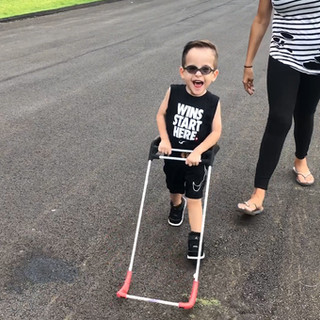
Empowering Exploration: The Role of the Pediatric Belt Cane in Summer Adventures for Children with an MVI/B
At the heart of mobility development is the idea that children with an MVI/B learn best by living mobility.
Grace Ambrose-Zaken
May 20


What Is the Goal of the Push Toy for MVI/B Toddlers?
Where Push Toys Fall Short
Push toys were never designed as mobility tools. And when you look at them through that lens, the limitations are obvious:
They don’t travel well (try fitting one in a car or airplane)
They don’t function in real environments (grass, gravel, uneven terrain)
They’re difficult to steer and control
They don’t fit into daily life (classrooms, tight spaces)
They offer no practical strategy for stairs
Grace Ambrose-Zaken
Mar 22

From Tears to Triumph: Marlowe's Journey to Independence with the Belt Cane
We’re thrilled to share our newest YouTube video, “From Tears to Triumph: Marlowe’s Journey to Independence with the Belt Cane.” In this inspiring story, you’ll meet Marlowe, a three-year-old girl who is blind and, like many children with visual impairments, faced overwhelming challenges as she tried to navigate her world.
Beaux Jettson
Mar 11


Understanding Blind Walking: How Extended Touch Enables Balanced Walking
Mobility tools (Belt Cane, rectangular cane, long cane, and human guide) all share a common feature, they provide body-to-device-to-surface link. They allow the blind person to touch the ground ahead this additional sensory information helps stabilize walking in much the same way vision does. When a cane touches the ground, it sends signals to the brain about the surface and body position, acting as an extension of the sensory system.
Grace Ambrose-Zaken
Jan 28


Why Pediatric Belt Canes Improve Child Mobility: A Pediatric Mobility Aid Guide
When a child faces challenges with mobility due to visual impairment or blindness, every step can feel like a mountain to climb. But what if there was a way to make those steps easier, safer, and more confident? That’s where pediatric mobility aids come into play. Among these, the Belt Cane stands out as a remarkable tool that can transform a child’s independence and daily life. Let’s explore why Pediatric Belt Canes improve child mobility and how they can make a real differ
Beaux Jettson
Jan 22


Celebrating Generosity: Ovintiv's Impact on Children with Visual Impairments
At Safe Toddles, we often find that the most meaningful support begins with a story. Today, we want to share one such story and express our deep gratitude to Ovintiv USA Inc. for their generous $5,000 donation through the 5 for a Cause employee giving initiative. This gift is more than financial support—it is a powerful reminder of how compassion and community can open doors for children with unique challenges.
Grace Ambrose-Zaken
Dec 23, 2025


Empowering Mobility with Pediatric Mobility Aids: A Guide to Belt Canes and More
When a child faces challenges with vision, mobility becomes a crucial part of their independence and confidence. Pediatric mobility aids are designed to support children in navigating their world safely and effectively. These tools are not just devices; they are bridges to freedom, exploration, and self-reliance. Today, I want to share insights about one such essential aid and the broader landscape of pediatric mobility aids that empower young lives.
Grace Ambrose-Zaken
Dec 11, 2025


Why Pediatric Belt Canes Improve Mobility: A Guide to Pediatric Mobility Aids
When it comes to helping children with visual impairments navigate the world safely and confidently, the right tools make all the difference. Pediatric mobility aids are designed specifically to meet the unique needs of young users. Among these aids, one stands out for its practicality and effectiveness: the pediatric belt cane. This tool is more than just a cane; it’s a bridge to independence, safety, and confidence for children learning to move through their environment.
Grace Ambrose-Zaken
Dec 1, 2025


🧭 It’s Not Orientation, It’s Mobility: A Thought Experiment for Parents of Blind Children
Most people assume blind children don’t know where they are — but the real challenge isn’t orientation, it’s mobility. In this eye-opening thought experiment, you’ll discover how blind kids can confidently know their space, yet still need tools like the white cane to move safely. Try it yourself: close your eyes, navigate your home, and gain a deeper understanding of what your child truly experiences.
Grace Ambrose-Zaken
Sep 29, 2025


Why Does a Blind Child Need a White Cane Arc for Safety, and what is it?
The white cane arc is an essential tool for anyone with a mobility visual impairment or blindness (MVI/B). Yet, children with an MVI/B struggle to even hold the long cane much less sweep it back and forth with each step. Children can push a static white cane arc in front of them. The static white cane arc is when it is built into the device.
Grace Ambrose-Zaken
Sep 9, 2025


1960s Part 2: O&M Goes to School
The entire field of orientation and mobility (O&M) exists because of the dog guide and, later, the long cane. Both were developed in response to war. Dog guides emerged after World War I, and the long cane after World War II, to serve newly blinded veterans—adults who had walked confidently with vision for decades before losing it. As a result, the curriculum for teaching independent travel was designed around a very specific learner: a physically fit, cognitively intact adul
Grace Ambrose-Zaken
Apr 6, 2025
bottom of page