


Understanding Blind Walking: How Extended Touch Enables Balanced Walking
Updated: Feb 19
Walking without sight is often seen as a challenge defined by what is missing: vision. Yet, focusing on the sensory system that is missing or impaired to better understand blind or mobility visually impaired (MVI/B) walking seems akin to trying to understand how bees fly by examining bird flight.
Researchers who study bipedal walking have used the negative impacts of blindness on walking to further prove the dominance of the visual system. This approach has led many to the conclusion that balanced walking without vision is nearly impossible. Yet, much like the early mistaken belief calculation that concluded bee flight was impossible; bees can fly by using their flight muscles differently and balanced MVI/B walking is possible when they are able to enhance their sense of touch.
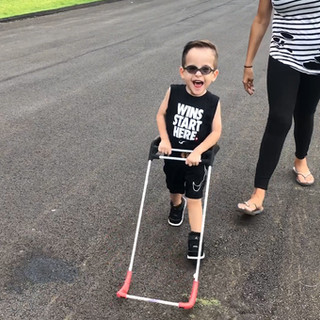
This post explores how extended touch of mobility tools enables balanced MVI/B walking, offering insights for families and therapists supporting individuals use of their Pediatric Belt Cane and other mobility tools during daily activities of living.

Balance Without Vision is Touch
From an engineering perspective, bipedal balance is impossible without sensory feedback. Infants, for example, can be compared to a pencil balanced on its tip: a small disturbance can cause them to lose balance and fall. For sighted individuals, vision becomes the dominant sense for balance. When vision is absent, touch becomes the dominant sense for balance.
Yet, it is not just any type of touch that aids standing and walking balance. For example, studies show that even adults who were born with an MVI/B do not develop superior sensorimotor balance skills. When tested without their mobility tools, MVI/B individuals’ were unable to maintain balance while standing on a moving surface. Yet, when allowed to hold on to a stable surface they were able to maintain balance.
Without a mobility tool, visual deprivation affects locomotion to a greater extent in children than adults including greater postural sway and slower walking speed, less step frequency and shorter stride length supporting the hypothesis that early gait adaptations are related to balance problems resulting from lacking both visual and tactile feedback.
Since 2017, Safe Toddles has been working to counteract these balance challenges in young children through the Belt Cane. Small and large-scale studies of children with an MVI/B wearing Pediatric Belt Canes have shown significant increase in the amount of walking, simply by putting the Belt Cane on.
How Touch Senses Support MVI/B Walking
Mobility tools (Belt Cane, rectangular cane, long cane, and human guide) all share a common feature, they provide body-to-device-to-surface link. They allow the MVI/B person to touch the ground ahead this additional sensory information helps stabilize walking in much the same way vision does. When a cane touches the ground, it sends signals to the brain about the surface and body position, acting as an extension of the sensory system.
Research by Jeka and colleagues in 1996 was among the first to show that using a mobility tool improves postural stability in MVI/B individuals. The mobility tool provides continuous touch feedback, helping the brain adjust balance in real time.

Practical Implications for Families and Therapists
It is good to recognize that touch interactions often look and feel very different from visual interactions. Yet, they achieve the same result.
Obstacle Detection:
Vision movement appears smooth. The child sees the obstacle and can avoid without any contact at all.
Touch movement appears choppy. The child only detects obstacles they contact which can cause sudden stops, and other interruptions.
Mobility tools provide extended touch feedback which allows the child to touch the obstacle through the mobility tool at a safer, more palatable 2-step distance. It may appear jerky when this happens, but considering each contact with a mobility tool is one less on the shin, those sudden stops are signs of success.
For Families
Encourage use of a mobility tool: The right mobility tool becomes a sensory aid that improves balance.
Create opportunities for fun: play games, go to festivals, seek out sport that includes the mobility tool
Support daily activities of living: Encourage child wearing the Belt Cane to master their dressing, washing, toileting, and household chores. The two-step touch makes interacting with objects and surfaces more enjoyable. Interacting in daily routines builds spatial awareness.
For Therapists
Focus on multisensory training: Balance training should include exercises that enhance touch, proprioception, and vestibular input.
Use assistive devices across all activities: Incorporate mobility devices in the routines to take maximum advantage of the balance and protective properties needed by the child with a mobility visual impairment or blindness.
Rethinking Balance and Mobility Without Vision
The traditional view that balanced walking requires vision is incomplete. Like the early misunderstanding of bee flight, it underestimates the body’s ability to adapt and use other senses.
MVI/B walking is possible and can be balanced when the sensory system adapts to take maximum advantage of their sophisticated touch system. This understanding opens new pathways for supporting blind individuals in gaining independence and confidence in movement, pairing all movement activities with mobility tools.
Families and therapists play a crucial role in recognizing and fostering these sensory adaptations. By focusing on the strengths and capabilities beyond vision, they can help individuals with an MVI/B navigate the world with greater stability and freedom through their dominant sense of touch.


Comments