top of page


Balanced, Protected, and Informed O&M for Active Daily Living
Dr. Grace Ambrose-Zaken


The True Cost of Waiting: What Happens When a Blind Baby Has No Mobility Tool?
The first article in “The Cost of Waiting,” a series examining what happens when we fail to invest in appropriate mobility technology for young children with a mobility visual impairment or blindness.
Grace Ambrose-Zaken
Sep 3

When does a child need a mobility device?
When deciding whether a blind child needs a mobility device, are we asking the right questions? A clearer developmental framework starts with the child's need for protection and environmental information—not motivation, cane failure, social acceptability, or other unnecessary barriers.
Grace Ambrose-Zaken
Sep 1


Safe Toddles Receives Support from Nicholas B. Ottaway Foundation to Advance Blind Baby Safe Mobility Program
Safe Toddles is pleased to announce a $17,500 grant from the Nicholas B. Ottaway Foundation to advance Phase III of the Blind Baby Safe Mobility Program. Building on the Foundation's continued support, this next phase will help professionals navigate insurance, IEP, and IFSP systems to secure access to Pediatric Belt Canes and advocate for children to have consistent access to their mobility devices throughout daily life, including school, sports, recreation, and community ac
Grace Ambrose-Zaken
Jul 22


Ready for the Whole School Day: Summer Practice with the Pediatric Belt Cane
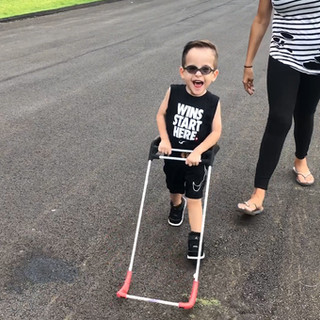
Independent mobility is not learned in a single lesson. It grows through everyday experience: every playground visited, every restaurant explored, every family outing, and every walk around the neighborhood. When children with an MVI/B trust the information provided through extended touch feedback of the Belt Cane, they gain more than mobility. They gain confidence, connection, and the freedom to belong.
Grace Ambrose-Zaken
Jul 18


Every Blind Child Deserves Independence
Every child deserves the freedom to explore. Read Wesley's inspiring story and discover how mobility support helped a blind toddler move toward people, play, and independence.
Grace Ambrose-Zaken
Jun 6


Building Walkers: A Daily Mobility Framework for Young Blind Children Using the Belt Cane
This is a walking plan to help parents and professionals build early walking skills through providing children with a mobility visual impairment or blindness daily recommended hours of meaningful movement every day paired with extended touch feedback.
Grace Ambrose-Zaken
Apr 24


You Are Not Alone
You Are Not Alone If you’ve been feeling this—if you’ve been quietly wondering, worrying, or questioning
You are not alone. There is nothing wrong with your blind child’s desire to move forward. They just need the right way to get there. And that is something we can change.
Grace Ambrose-Zaken
Mar 31


Why the Pediatric Belt Cane Changes Everything for Children with an MVI/B
At the core of the Belt Cane’s effectiveness is a simple but powerful concept: the triangle. By connecting at the child’s waist and extending outward to the ground, the Belt Cane completes a triangular base of support. This matters. A triangle is one of the most stable shapes in nature and engineering, and that same principle applies here.
Grace Ambrose-Zaken
Mar 30


Walking Has a Purpose: From First Steps to Meaningful Movement
Walking starts as a goal—then becomes a gateway. What once felt like a distant milestone becomes routine—and that’s exactly the point. Because once a child walks well, the world opens.
Grace Ambrose-Zaken
Mar 23

From Tears to Triumph: Marlowe's Journey to Independence with the Belt Cane
We’re thrilled to share our newest YouTube video, “From Tears to Triumph: Marlowe’s Journey to Independence with the Belt Cane.” In this inspiring story, you’ll meet Marlowe, a three-year-old girl who is blind and, like many children with visual impairments, faced overwhelming challenges as she tried to navigate her world.
Beaux Jettson
Mar 11


Blind Baby Safe Mobility CEU Courses: ACVREP-Approved Training for Orientation & Mobility and Vision Professionals
A New Era in Mobility for Learners with an MVI/B the Pediatric Belt Cane, long cane instruction begins after a child demonstrates the ability to walk and grasp a cane, leaving a critical developmental window unsupported. Safe Toddles educational programming addresses this gap at every age. Our training focuses on assessment and teaching strategies for child wearing the Pediatric Belt Cane, the only mobility tool recognized as a walking solution.
Grace Ambrose-Zaken
Mar 7


It’s Never Too Late: How the Pediatric Belt Cane Unlocks Walking Confidence for Children with an MVI/B
At approximately 12 months, the eyes of sighted children have physically developed to adult proportions. This shift allows vision to become the dominant source of balance feedback for walking. The Pediatric Belt Cane provides what the developing MVI/B body needs: enhanced tactile feedback.
Grace Ambrose-Zaken
Feb 23


Who Is Advocating for the Quiet Blind Child?
Allow blind children to wear the Pediatric Belt Cane—a mobility solution that extends touch feedback at the moment it is needed most, during early walking.
Allow them to move independently now, not someday.
Allow them to build balance through information, not fear.
Allow them to walk safely until they are old enough to speak for themselves and advocate for a long cane.
Grace Ambrose-Zaken
Feb 1


Understanding Blind Walking: How Extended Touch Enables Balanced Walking
Mobility tools (Belt Cane, rectangular cane, long cane, and human guide) all share a common feature, they provide body-to-device-to-surface link. They allow the blind person to touch the ground ahead this additional sensory information helps stabilize walking in much the same way vision does. When a cane touches the ground, it sends signals to the brain about the surface and body position, acting as an extension of the sensory system.
Grace Ambrose-Zaken
Jan 28


The Belt Cane Balance Advantage: The Walking Solution Parents Have Been Looking For
Clinical Ophthalmology published an article called The Role of a Pediatric Belt Cane in Children with Cerebral Visual Impairment a pilot study that used smartphone videos from 11 children with clinical diagnosed CVI at baseline and 8-week follow-up while wearing a Pediatric Belt Cane. Belt Cane use was associated with improved gait speed, with supportive improvements in step length and foot-mobility. That's because bipedal ambulation (walking) is not possible without unaltere
Grace Ambrose-Zaken
Jan 23


Why Pediatric Belt Canes Improve Child Mobility: A Pediatric Mobility Aid Guide
When a child faces challenges with mobility due to visual impairment or blindness, every step can feel like a mountain to climb. But what if there was a way to make those steps easier, safer, and more confident? That’s where pediatric mobility aids come into play. Among these, the Belt Cane stands out as a remarkable tool that can transform a child’s independence and daily life. Let’s explore why Pediatric Belt Canes improve child mobility and how they can make a real differ
Beaux Jettson
Jan 22
bottom of page