


It’s Never Too Late: How the Pediatric Belt Cane Unlocks Walking Confidence for Children with an MVI/B
For decades, families and professionals have asked the same heartbreaking question: Why is my child with a mobility visual impairment or blindness (MVI/B) hesitant to walk without a helping hand?
Today, we understand the answer. And more importantly — we have a solution.

The Missing Piece Behind Walking Delays in Children with an MVI/B
Bipedal walking is a motor skill that depends on reliable sensory feedback — either vision or touch.
In early development, touch is the first and primary sense supporting balance and walking.
Typical early touch-based balance milestones include:
Pulling to stand (around 10 months)
Cruising along furniture (around 11 months)
Walking with one hand held (around 12 months)
At 12 months, the eyes of sighted children have physically developed to adult proportions. This shift allows vision to become the dominant source of balance feedback for walking.

But for a child with an MVI/B, that visual transition cannot occur.
When we remove hand-based balance support from a young child with an MVI/B, we need to replace it with extended touch feedback through a mobility tool. Otherwise, we are asking them to balance using only their two feet and for children under six years of age, that simply isn’t enough.

This is not reluctance. It is not behavioral. It is not lack of motivation.
It is a sensory problem — and sensory problems require sensory solutions.

The Pediatric Belt Cane: Extended Touch for Walking Confidence
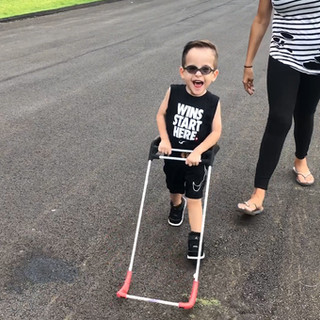
The Pediatric Belt Cane provides what the developing body needs: enhanced tactile feedback.
Unlike structural mobility supports, the Belt Cane:
Adds two additional points of contact
Extends tactile feedback two steps ahead
Provides a protective frame that reduces unwanted bodily collisions
Uses omni-wheel tips that glide smoothly to deliver reliable anticipatory input
This frame is not meant to hold a child with an MVI/B up.
It provides contextual support, the kind that allows a child to move freely, safely, and with anticipation.
We all require at least two reliable warning steps to slow down, change direction, or reach for a handrail. Sighted individuals use vision for anticipatory control. Children with an MVI/B use touch for anticipatory control.

Visual Anticipatory Control vs. Tactile Anticipatory Control
Visual anticipatory control uses sight to avoid collisions.
Tactile anticipatory control uses extended touch feedback, such as a full cane arc, to prevent unwanted bodily impact, aid balance, and collect information about the path ahead.
The Pediatric Belt Cane delivers tactile anticipatory control in a developmentally appropriate way. It allows children with an MVI/B to move forward with awareness and confidence.
When Should a Child with an MVI/B Begin Using a Pediatric Belt Cane?
The appropriate age to begin is as early as 10 months, when early standing and cruising emerge. And there is no upper age limit for benefiting from extended tactile feedback and it is never too late to start.

Covered as Assistive Technology
The Pediatric Belt Cane is covered by most insurance providers and qualifies under IDEA (Individuals with Disabilities Education Act) as assistive technology.
For children with an MVI/B the Belt Cane is not an optional accessory. It is a walking solution.
Research, Curriculum, and Professional Support
At Safe Toddles, we are committed to advancing pediatric mobility innovation.
We offer:
A structured curriculum (Blind Baby Safe Mobility Curriculum)
Hundreds of instructional videos (@SafeToddles)
Professional webinars
The largest IRB-collected and cataloged video library of early MVI/B walking with and without mobility tools and other devices
Our data confirm what families observe: When children with an MVI/B receive appropriate tactile feedback, they move more. They explore more. They smile more.
This is also an exciting moment for our field. With 3D printers and A.I. we can continue innovating mobility tools. Children with an MVI/B deserve lots of choice in the tools they use at home, school, in the community, in sport, and at play.
Walking With Joy Is Possible
The long cane was an important beginning. The Pediatric Belt Cane is the next step forward for MVI/B childhood mobility.
Children with an MVI/B cannot wait until they are older to feel safe and balanced moving independently. They need the right sensory input now.
If you would like to learn more about how the Pediatric Belt Cane can support a learner in your care, we would love to connect with you.
Because every child with an MVI/B deserves to walk with joy.


Comments