


Look What $10,000 Made Possible: The Big-Kid Belt Cane Project
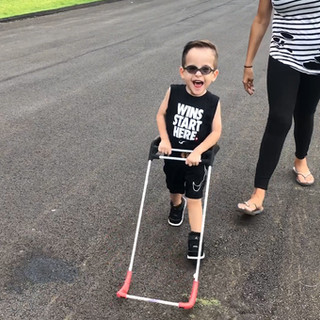
How a grant from the Gibney Family Foundation helped Safe Toddles build a more stable Belt Cane frame for older children and young people who need extended touch feedback to walk independently because they are blind or mobility visually impaired.
For Safe Toddles, that question became a challenge we were determined to solve.
Thanks to a $10,000 grant from the Gibney Family Foundation, Safe Toddles was able to bring together engineers, researchers, students, staff, and volunteers to develop a more stable Big-Kid Belt Cane frame—opening the door to mobility for children and young people who need a larger solution.
And the results have been remarkable.
From Holding a Hand to Walking Independently
One of the most powerful examples comes from the oldest blind person currently wearing a Belt Cane: a 19-year-old young woman.
Her teacher told us that before using the Belt Cane frame, she would only walk when holding an adult's hand. She is nonverbal and depended on an adult to provide that physical connection while walking.
Today, she walks independently.
And she has developed her own way of communicating about her mobility.
She uses her word “click” to tell her teacher that she wants her Belt Cane frame fastened before she stands up to walk.
That small word represents a remarkable change.
She isn't simply being taken somewhere.
She is communicating that she is ready to walk.
The Belt Cane frame has become her requirement before engaging in independent walking.
Solving a Design Challenge
Creating a Big-Kid Belt Cane was not simply a matter of making the existing frame larger.
As children grow, the engineering requirements change. We needed to improve the stability of the frame and improve the ergonomic fit of the belt while maintaining the tactile connection and mobility advantages of the Belt Cane.
The Gibney Family Foundation's $10,000 grant gave us the resources to tackle that problem.
The grant supported:
Engineering expertise
A new 3D printer
Materials for prototyping and fabrication
Design and development work
The result was an improved frame that provides greater stability for larger users.
A Remarkable Team Behind the Big-Kid Belt Cane
This project brought together an extraordinary group of people with different skills and perspectives.
From the City University of New York and City College of New York, we were fortunate to work with engineering seniors Lucca Goldberg and Michael McLean, and an engineering doctoral student Mojtaba Belali Koochesfahani.
We also benefited from the 3D-printing expertise of Winston Law, a high school senior at Edison High School.
Safe Toddles co-founder and Chief Engineer Distinguished Professor Marom Bikson brought engineering leadership to the project.
Safe Toddles co-founder and renowned Orientation and Mobility expert Dr. Grace Ambrose-Zaken brought the developmental and mobility perspective that drives the Belt Cane concept.
Together, this team helped turn a mobility challenge into an engineering opportunity.
See What Your Support Made Possible
We created a video to show you this project—from the people who worked on it to the design process and the resulting Big-Kid Belt Cane frame.

This is what investment in innovation can look like.
A grant can purchase a 3D printer.
It can purchase materials.
It can pay engineers.
But ultimately, it can create an opportunity for someone to move differently through the world.
Help Us Build What Comes Next
The Big-Kid Belt Cane frame is an important step forward—but there is much more work to do, and continued support can help Safe Toddles reach more children and young people.
With additional innovation, testing, and development, we can bring safe, independent mobility to the playing field and the community of learners who are still underserved by the existing mobility tool choices.
We are deeply grateful to the Gibney Family Foundation for its $10,000 investment in this project, to Stan Young for his sponsorship and support, and to every engineer, student, researcher, volunteer, staff member, family, donor, and supporter who helped make this work possible.
You helped us move an idea forward, build something new, and see what may be possible when a blind person who once needed to hold an adult’s hand can stand up, say “click,” and get ready to walk independently.
The next breakthrough may be waiting for another child born with a mobility visual impairment or blindness.
Your donation or sponsorship can help Safe Toddles continue the engineering, innovation, testing, and development needed to bring safe mobility solutions to more blind and mobility-visually-impaired children and young people.
Imagine what we can make possible together.


Comments