


What the World Loses If Safe Toddles Doesn’t Succeed
- Grace Ambrose-Zaken
- 18 hours ago
- 3 min read
There are ideas that feel optional—nice to have, interesting, innovative. And then there are ideas that quietly hold the potential to change the trajectory of lives. Safe Toddles is one of those.

If it doesn’t succeed, the loss won’t be measured in sales or missed market opportunities. It will be measured in delayed steps, in lowered expectations, in children who could have walked sooner—but didn’t. It will be felt in families who never discover that independence was possible earlier, easier, and with more joy.
At its core, Safe Toddles is about solving a problem that has been normalized for far too long: the walking delay in blind and mobility visually impaired children. For decades, this delay has been explained away, minimized, or disconnected from the tools we provide. Children are encouraged to wait. To sit. To be carried.
To “get ready” before they are given meaningful mobility tools.
But what if readiness isn’t the issue?

What if the issue is that we have not provided the right kind of feedback—the kind that sighted children receive constantly through vision, and blind children must receive through touch?
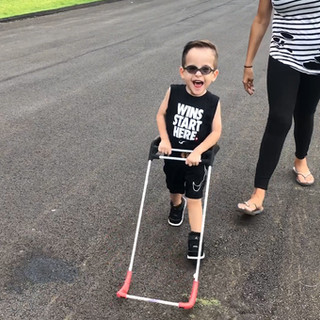
The Pediatric Belt Cane changes that equation. It extends touch. It brings the environment two steps closer. It gives the child a continuous stream of information about what is ahead—surface changes, obstacles, spatial boundaries—before their body encounters them. And with that information comes something powerful: balance, confidence, and the ability to move.
If Safe Toddles doesn’t succeed, we risk continuing a cycle where:
Walking delays are accepted instead of prevented
Sitting becomes the default activity instead of movement
Independence is postponed rather than expected
Families are told to wait, instead of being empowered to act
The loss compounds over time. A child who walks later explores less. A child who explores less has fewer opportunities to build spatial understanding, strength, coordination, and confidence. That gap doesn’t stay small—it grows.
Communities feel this too. Classrooms adapt to children who are less mobile. Expectations shift downward. Professionals work within a system that has quietly accepted limitation as inevitable. Innovation stalls—not because solutions don’t exist, but because they aren’t adopted.
And perhaps the greatest loss is invisible: the loss of belief.
Belief that a blind child can walk early.
Belief that independence doesn’t have to wait.
Belief that the right tool, at the right time, can change everything.
Safe Toddles challenges long-held assumptions. It asks parents, professionals, and communities to reconsider what is possible—not someday, but now. And that kind of shift is never easy. It requires openness. It requires courage. It requires people willing to say, “Maybe we’ve been missing something.”
If Safe Toddles doesn’t succeed, it won’t just be a product that fades away. It will be an idea that didn’t get the chance to fully take root. And the cost of that will be carried by the very children who stand to gain the most.
But if it does succeed—if families embrace it, if professionals stay curious, if communities support earlier mobility—then the opposite becomes true.
We gain children who walk sooner.
We gain confidence where there was hesitation.
We gain independence that starts in the earliest years and builds forward.
We gain a new expectation: that blind children move through the world with the same freedom, curiosity, and momentum as any other child.
That is what is at stake.
And that is why it matters.


Comments