


Why the Pediatric Belt Cane Changes Everything for Children with an MVI/B
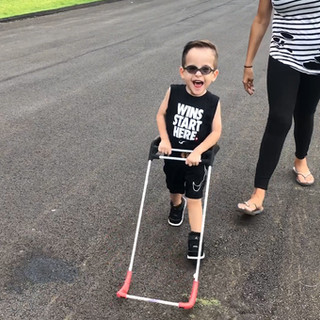
When a child is identified with a mobility visual impairment or blindness (MVI/B), we work hard to give them everything they need to thrive—early intervention, enriching environments, inclusive play, and meaningful social interaction. Now, a mobility tool that truly matches how a child learns to move.
The Pediatric Belt Cane offers something fundamental to the child with an MVI/B. It isn’t a tool a child holds—it’s a system that works with their body, shaping how they experience movement, space, and independence from the very beginning.
Stability Begins with Shape: The Power of the Triangle
At the core of the Belt Cane’s effectiveness is a simple but powerful concept: the triangle.
By connecting at the child’s waist and extending outward to the ground, the Belt Cane completes a triangular base of support. This matters. A triangle is one of the most stable shapes in nature and engineering, and that same principle applies here.
Instead of relying on a single point of contact (like a handheld cane), the child now moves within a stable, grounded structure. This added stability allows for more confident steps, fewer hesitations, and a stronger sense of control over movement.

Extended Touch: Information Before Impact
For an MVI/B child, touch is not just helpful—it is essential. But timing is everything.
The Belt Cane extends into the child’s path, providing what can be thought of as a “two-step warning.” This means the child receives information about obstacles before reaching them, allowing time to process, adjust, and respond.
This extended touch feedback transforms movement from reactive to proactive. Instead of bumping into the world, the child begins to anticipate it. That shift builds not only safety, but confidence and curiosity.
Spatial Awareness: The Polygon Effect
As the child moves with the Belt Cane, the shape created is no longer just a triangle—it becomes a dynamic polygon that surrounds the child’s forward movement.
This shape does something remarkable: it naturally creates space.

The child maintains a buffer between themselves and objects, walls, and people. This “social distance” is not taught—it’s felt. Over time, the child begins to understand how space works, how to navigate around others, and how to move fluidly through different environments.
Personal Space: The Protective Rectangle
In motion, the Belt Cane also establishes a rectangular field of protection in front of the child. This creates a consistent, predictable zone—a space the child can trust.
Within this protective rectangle, the child experiences something many blind children are denied early on: the ability to move forward without constant physical guidance from an adult.
It also supports social development. By maintaining a natural conversational distance, the child can engage with others more comfortably, without being physically tethered or crowded.

Connecting It All: Why This Leads to Success
Each of these elements—the triangle, extended touch, polygon spacing, and protective rectangle—works together as a unified system.
Stability reduces fear.
Early feedback builds anticipation.
Spatial awareness fosters independence.
Personal space supports confidence and social interaction.
And when those pieces come together, something bigger happens.
The child doesn’t just move—they explore.
They don’t just avoid obstacles—they engage with their environment.
They don’t just follow—they begin to lead their own movement.
That is the true success of the Pediatric Belt Cane. It shifts mobility from something managed by adults to something owned by the child. And in that shift, we see more communication, more curiosity, more connection—and ultimately, more independence.
Because when a child has the right foundation, everything built on top of it becomes stronger.


Comments