


The Hidden Harm of Sitting: Even More Concerning in Children with Blindness
Updated: May 9
Sitting has quietly become the default position of childhood. In classrooms, therapy sessions, and even at home, young children are often expected to sit—calmly, safely, and for long stretches of time. For sighted children, this trend is already raising concerns about physical health, attention, and development. But for children with a mobility visual impairment or blindness (MVI/B), the consequences run deeper—and seem often overlooked.

Sitting Is Not Neutral
Sitting is often framed as harmless, even productive. It’s where learning happens, where children are “engaged,” where things feel controlled and manageable. But sitting is not a neutral activity for a developing child.
Movement is how young children learn about their bodies, their environment, and their own capabilities.
When movement is limited, so is development:
Balance does not fully emerge
Gait remains immature
Foot strength and alignment are underdeveloped
Confidence in mobility never fully forms
For children with an MVI/B, who rely on movement and touch rather than vision to understand the world, the cost of sitting is even greater.
For children with an MVI/B the cost of sitting is even greater.
The Cultural Expectation: Blind Children Sit
Look at how blindness is portrayed in media, classrooms, and even professional practice. Blind children are often shown sitting—at desks, on the floor, or beside an adult. Quiet. Contained. Safe.
This isn’t accidental. It reflects a deeper, unspoken assumption: that independent movement is limited, difficult, or even unrealistic.
But sitting is not the solution. It is the outcome of an unsolved problem.
The Unasked Questions
In many educational and therapeutic settings, there is a disconnect that goes largely unexamined:
Why is the long cane hanging on the wall for most of the day?
Why is it only used during designated “mobility time”?
What is the child doing the other 5–6 hours of the day?
Often, the answer is simple: sitting.
Even more concerning is when a child cannot use a long cane independently without constant verbal prompting—“swing left, swing right”—yet this is still considered functional mobility. If a child cannot initiate and sustain movement on their own, then mobility has not truly been achieved.
And when that child returns to the classroom, where movement is not expected or supported, sitting becomes the default again.

The Cycle of Low Expectation
Parents trust professionals. When they are told, “This is the best your child can do,” they believe it—because historically, that has often been true.
But that belief creates a cycle:
Limited mobility leads to more sitting
More sitting leads to less physical development
Reduced development reinforces low expectations
Low expectations justify continued sitting
Over time, this cycle becomes the norm.
Solving the Walking Problem
If sitting is the outcome, then the real question is: how do we solve the walking problem?
The answer is not more verbal prompting, longer lessons, or occasional mobility sessions. The solution is giving the child continuous, reliable tactile information while they move—through a tool that works with their dominant sense: touch.
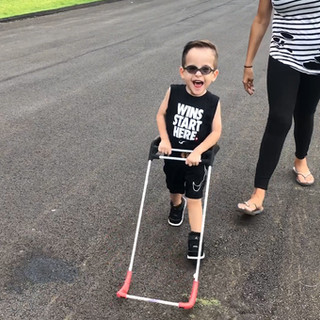
This is where the Pediatric Belt Cane—a wearable white cane—changes everything.

Worn starting as early as 10 months, the Belt Cane provides constant, two-step tactile feedback through contact with the environment. It extends the child’s sense of touch beyond their body, allowing them to anticipate surfaces, maintain balance, and move with confidence.
Unlike handheld tools that require instruction and prompting, the Belt Cane works all day—passively, consistently, and in sync with the child’s natural movement.
Built for the Way Children Actually Learn
Young children learn through repetition and immersion—not short, isolated sessions.
That means mobility must be:
Continuous
Integrated into daily routines
Available across all environments
By age two, children are recommended to engage in 6 to 8 hours of physical activity per day. For a blind child, that activity must include meaningful, independent walking.
The Belt Cane supports this by making safe, confident movement possible throughout those hours—not just during a lesson.
What Happens When Walking Works
When children wear the Belt Cane consistently during their active hours, professionals and families are seeing:
Significant increases in daily walking and exploration
Noticeable improvements in gait and posture
Stronger, more coordinated foot movement
Reduced reliance on constant verbal prompting
Greater independence across environments
Most importantly, children are no longer defaulting to sitting. They are moving, initiating, and engaging with the world around them.
Walking Is the Foundation, Not the Reward
Walking should not be something a child earns after mastering other skills. It is the foundation that supports all other learning.
When a child can move confidently:
They participate more fully
They explore more freely
They learn more naturally
They sit less—because they no longer need to
A Necessary Shift
The issue is not that children are sitting. The issue is that they are sitting because walking has not been made accessible.
For too long, sitting has been accepted as inevitable for blind children. It is not.
With the right support—continuous, tactile, wearable support—children can spend their day as they are meant to: moving.
Call to Action
If you are a parent, educator, or therapist, look closely at your child’s day:
How many hours are spent sitting versus moving?
Is movement independent or constantly prompted?
Is mobility available all day—or only in short sessions?
If walking is not working, it’s time to change the approach.
The Pediatric Belt Cane offers a way forward—starting in infancy, supporting 6–8 hours of daily movement by age two, and replacing sitting as the default with confident, independent walking.
Because when the walking problem is solved, everything else opens up.
To learn more about integrating the Belt Cane into an MVI/B child's daily physical activities and obtain ACVREP CEUs go to our curriculum and courses: https://safetoddles.podia.com/
The Blind Baby Safe Mobility curriculum was funded by generous donations Nicholas B. Ottaway Foundation, the Delta Gamma Foundation, and people like you.


Comments