


Is a Belt Cane Safe for My Child to Use?
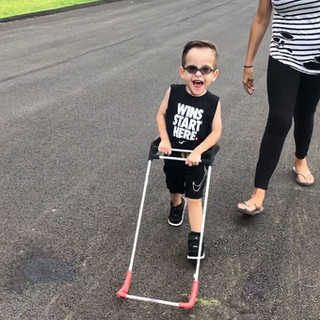
By Grace Ambrose-Zaken, Ed.D., orientation and mobility specialist and co-inventor of the Pediatric Belt Cane
A properly fitted Pediatric or Big-kid Belt Cane can help a child with a mobility visual impairment or blindness (MVI/B) move more safely by giving them information about the path ahead through touch. Parents also deserve to know what happens when their MVI/B child plops onto the floor, stumbles, or catches a wheel on furniture. Those are everyday moments, and they tell us a lot about how the cane needs to work.
What happens when my child sits down or stumbles?
When an MVI/B toddler plops down, the frame extends out in front of them. The magnetic connections let the frame swivel up and down while staying attached, so the frame can change angle as the child sits.
What happens during a stumble depends on what the cane frame meets. If the wheels are free to roll, the frame can roll ahead as the child goes down. If a wheel or the frame catches, the magnets can release. The cane frame’s job during walking is to give the child with an MVI/B advance information about the path. A child wearing one can still fall.
Why does feeling the path two steps ahead matter?
Think about a doorway threshold. If your foot is the first thing to hit it, you have to recover from the surprise while you’re already taking the step. When the cane tips reach it first, you have time to pause and decide what to do. I’ve watched MVI/B children stop when the frame touches furniture, reach down to feel the frame, or turn to free the tips and keep going. Sometimes the most meaningful thing I see is a child with an MVI/B standing quietly in the middle of a room, taking a moment before choosing their next step.
In my orientation and mobility work, I look at what an MVI/B child can reliably find while moving. A child may see a light across the room and still miss what’s directly in their path. At home, they may move by keeping a hand on the furniture or wall. At school, they may walk slowly even with a guide. When every step takes that much effort, it makes sense that a child with an MVI/B might prefer the stroller. The question I ask is whether that child has enough information about the next step to choose to take it.
What Ysabella taught me about the next step
Before Ysabella received her first Belt Cane at age four, she cried when her foot hit a doorway threshold. She was described as tactilely defensive, disliked walking, and often rode in a stroller. With the Belt Cane, she learned to enjoy feeling what the cane tips encountered. Touch was now giving her information before her foot reached the change in the floor. Her story makes that difference easier to see than any description of the device.
How can I tell if the Belt Cane fits?
When I check a fit, I look for three things.
The belt is snug. When I close it, the top hook-and-loop tab reaches about halfway across the lower fastening area.
The black handles are parallel to the floor when the child is standing.
The frame stays centered ahead as the child walks. If it easily swings off to one side, the fit needs attention. Safe Toddles
If the frame repeatedly catches, swings aside, or comes loose, ask Safe Toddles or your child’s orientation and mobility specialist to recheck the fit and find out what’s happening. While you’re arranging the correction, stay close enough to help keep the frame positioned if your child uses it with you. If you can’t keep it aligned, pause independent use until the fit is corrected.
How close should I stay around stairs and drop-offs?
Think of how you supervise any active toddler. Stay close enough to step in around stairs, drop-offs, and unfamiliar surfaces. How much help you give depends on your child’s balance, experience, and the setting. Give them time to respond to what the cane frame touches when the setting allows it, and provide direct help when the next step is beyond what they can safely manage.
In an eight-week observational pilot I co-authored, 11 children with cerebral or cortical visual impairment walked faster on average at follow-up while wearing their Belt Canes. The study measured walking performance. It did not establish how often falls or injuries occur during daily use. PMC
I want families to think about safety every time their MVI/B child gets up to move, whether they’re crossing the living room or joining classmates in the hallway. A well-fitted Belt Cane can give your child with an MVI/B information they can act on for themselves. Your job is to make sure they have that information and to stay close enough to help when they need you.


Comments