


What Is a Belt Cane and How Does It Help My Child?
By Grace Ambrose-Zaken, Ed.D., orientation and mobility specialist and inventor of the Pediatric and Big-kid Belt Canes
One of the biggest milestones I look for when a child with a mobility visual impairment or blindness (MVI/B) starts wearing a Belt Cane is easy to miss. The child stands quietly in the middle of the room.
Before that, they might have held on to a hand or a piece of furniture, taken a few steps, and sat down as soon as there was nothing to hold. Getting across the room could feel like a chore. Then one day they let go and stand there. For that MVI/B child, standing still in the open can be as meaningful as taking another step. I’ve seen children with an MVI/B go from taking a few hesitant steps to walking willingly and, eventually, doing what children do when they get the chance: running off to see what’s next.

What does a Belt Cane do?
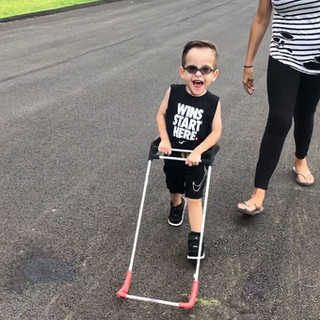
Pediatric and Big-kid Belt Canes are wearable white canes. Belt canes have a lightweight frame with rolling tips attaches magnetically to a custom-fitted belt. The belt helps keep the frame aligned in front of your child as they move, so the tips can contact an obstacle or a change in surface about two steps ahead. We call that extended touch. It lets your child feel something beyond their reach, early enough to decide what to do with their next step. Safe Toddles
I often say touch feedback is honest. When the cane frame meets a sofa, the path stays blocked until your child changes direction. They can pause, feel where the frame stopped, and try turning. The frame gives them information they can check for themselves. That preview helps protect against forward collisions and can help an MVI/B child feel steadier as they decide where to step. The child supports their own weight. Safe Toddles
Why I designed a cane that a child can wear
When I taught orientation and mobility at Hunter College of the City University of New York, my sighted graduate students practiced using a long cane under blindfold. After about an hour, they could usually coordinate one sweep with each step. Once they trusted what the cane tip was telling them, they could turn their attention to finding a doorway or figuring out where they were.
That experience made me think differently about the young children I taught. An MVI/B child might learn to hold a long cane and still have difficulty coordinating the sweep reliably enough to find out what’s ahead with each step. I wanted children with an MVI/B to have access to the same information my blindfolded graduate students learned to rely on. Wearing the frame gives an MVI/B child that preview while they’re still learning to balance, walk, turn, and explore.
What can change in everyday life?
Letting go at age seven. A child I worked with was first considered for a Belt Cane at age three. Her family was advised against it at the time. By seven, she was taking three shaky steps between her mother and grandmother, falling into their arms or onto the couch to stop. She had yet to stand independently. When she put on the Belt Cane, she was able to let go. I saw a similar change in a 19-year-old who had relied on holding someone’s hand to walk and began walking without it. Those experiences are why I encourage families to consider extended touch at any age.
Crossing a doorway with CVI. At four, another child I worked with often rode in a stroller. When her foot struck a doorway threshold, she cried. With her Belt Cane, the tips found the threshold first. She came to welcome that contact and learned to walk over the threshold on her own. She began reaching out to touch things along the way and was eager to walk and explore.
A child with cerebral or cortical visual impairment (CVI) may see a bright light across the room and still have trouble seeing a threshold in time to step over it. I’ve seen children lower their heads or bend closer to inspect the floor while walking. With the cane previewing the path, some straighten up and look around on their own. They can use their vision for things they see reliably, like finding a light, while using touch to learn what’s in their path.
In a published pilot study I co-authored, 11 children with CVI walked an average of 66% faster at the eight-week follow-up while wearing their Belt Canes, compared with baseline. Their steps were also about 50% longer on average. Larger controlled studies are needed to confirm these findings. pubmed.ncbi.nlm.nih.gov
What should I watch for when my child starts?
Start by watching your child in a familiar space. The first change might be a quiet moment of standing or a small movement that tells you they’re curious about the feedback:
Reaching down to feel the frame or tapping the cane tips.
Pausing when the frame touches a piece of furniture.
Turning to free the tips and find a clear path.
Standing quietly in the middle of the room without reaching for a hand or furniture.
If your child is steady on their feet and you’re nearby in a familiar, safe space, let the frame make contact with the sofa or chair. Give your child a moment to feel what happened and see whether they find their own way around. If they’re still unsure, you can use that moment to help them find a clear path.
Sometimes the most helpful thing a parent can do is wait long enough to see what the child figures out.
How do I get started?
If your child is blind or has a visual impairment that affects how reliably they can see what’s in their path, I would start by asking how they can get reliable touch information during everyday movement. That question matters for children with CVI and for children who also have motor or intellectual disabilities.
My recommendation is to get a properly fitted Belt Cane early and give your child regular opportunities to use it throughout the day as they become comfortable. Think about the places they already want to go: across the living room to a favorite toy, through the kitchen doorway to join you, or down the hall to find someone they know. Safe Toddles can help you take the measurements, confirm the fit, and explore funding options. Get a Belt Cane


Comments