


Can a Pediatric or Big-kid Belt Cane Prevent Falls in Blind Children?
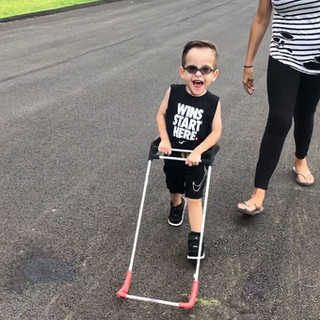
By Grace Ambrose-Zaken, Ed.D., orientation and mobility specialist and inventor of the Pediatric Belt Cane
A Pediatric or Big-Kid Belt Cane can help a child with a mobility visual impairment or blindness (MVI/B) avoid a trip or collision by giving them a chance to feel what’s ahead before they step. When the cane tips reach an obstacle before the child’s foot does, the child has time to stop, step up, or go around. That advance notice matters when a child’s vision is too unreliable to spot a hazard in time. Children can still fall while wearing a Belt Cane, and the amount of help they need depends on their skills and where they’re moving.

Some falls begin with a surprise
Imagine walking into a classroom and stepping on a toy you didn’t know was there. By the time you feel it underfoot, you’re already trying to regain your balance. Now imagine knowing it’s there two steps earlier. You have time to choose where to put your foot.
A properly fitted Belt Cane extends an MVI/B child’s sense of touch about two steps ahead. Contact through the cane frame gives the MVI/B child information they can use to adjust their balance and plan their next step. I watch for what the child with an MVI/B does with that information. They might lift a foot when the tips meet a raised surface, pause when the tips drop over an edge, or look for a clear route when the frame meets an obstacle.
In my study of 562 learners with visual impairments, walking with assistance was the most commonly reported way children walked. In my work with families, I ask what happens when a child wants to cross the room on their own. How do they find out what’s in the way before their foot reaches it? Read the study in the Journal of Visual Impairment & Blindness.
Watch what happens at a classroom doorway
In one of our videos, a four-year-old with cerebral visual impairment (CVI) walks down her school hallway in Alaska during a class change. In the clip filmed before she received her Belt Cane, she walks with a wide stance and an uneven, stop-and-go pace. Her mother walks ahead and takes her hand to guide her into the classroom.
In the Belt Cane clip, the child walks at a steadier pace and goes through the doorway first. The cane frame meets an object on the floor. She stops and goes around it. As she moves farther into the room, the frame finds more clutter. She keeps exploring, reaches out, and interacts with what’s around her.
The moment at the doorway is the one I’d ask parents to watch. She felt the obstacle before stepping on it and chose where to go next.
What Audrina’s fall shows
Audrina was three years old and the first Belt Cane user in New Mexico. In one video she runs, falls, and gets back up. She says the cane frame caused her to fall. Her teacher tells her she doesn’t have to run. Audrina starts running again, speeds up, and smiles.
I include that example because parents deserve to see what learning with the cane can look like. Audrina was eager to move, and she was still learning to respond to the frame at a run. When your child is learning, stay close enough to give the help they need, especially around steps, curbs, and drop-offs. Adjust how much help you give as you see what they can reliably manage in that setting.
What to watch for if your MVI/B child trips or falls
Notice when your MVI/B child first got information about the hazard. Did they know there was a step down before their foot reached it? Did they feel the cane tips touch an object and have time to go around? Or did they lose balance on a clear path? Describe what you saw to your MVI/B child’s orientation and mobility specialist. If your child with an MVI/B also needs physical help with standing or walking, share those observations with their physical therapist.
The first change you notice may be small. Your MVI/B child feels the frame touch something, pauses, and picks a different route. That’s the moment they’re learning to use information about the path before they take the next step.


Comments