


When Should My Blind Child Start Using a Cane?
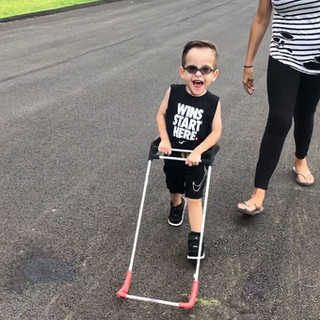
By Grace Ambrose-Zaken, Ed.D., orientation and mobility specialist and inventor of the Pediatric Belt Cane
If your baby is blind or has a visual impairment that makes it hard to see what’s ahead (mobility visually impaired), start the Belt Cane conversation when they begin practicing standing and bearing weight. Pulling up at the couch, standing with your help, and taking sideways steps along furniture are all good reasons to ask about a trial with a properly fitted Pediatric Belt Cane. These early skills come before independent walking.

If your MVI/B child is already walking but still leans heavily on your hand, on walls, or hesitates to cross an open room unless holding on to you, it’s worth asking about a trial now, too. I look at how an MVI/B child moves during everyday activities as well as what they can do during a lesson or therapy session.
Why the next step matters
Walking is a sensorimotor skill. An MVI/B child needs the strength and coordination to take a step and information about where that step will land. A sighted child who sees the edge of a rug can adjust before reaching it. An MVI/B child who can’t reliably see it first finds out it’s there when their foot meets the edge.
A Belt Cane is a wearable white cane. The belt holds the cane frame in front of the child so its tips can make contact with the floor and obstacles ahead. When the tips meet a rug edge or a piece of furniture, the child can feel that contact through the frame and decide whether to pause, explore, or change direction. In orientation and mobility, we call this tactile anticipatory control. It means getting information by touch in time to use it.
The CDC lists taking a few steps independently by 15 months and walking without holding on by 18 months as developmental milestones. I use those milestones to help families ask a practical question: What information does my MVI/B child have about the space ahead as they learn to stand and walk? Giving an MVI/B child access to that information can be part of teaching walking from the start. CDC
At 16 months, Hailey practiced standing
In my Walking 101 video, Hailey’s mom, physical therapist, and early intervention teacher help her practice standing. Watch how upright she becomes. With the cane frame in contact with the floor and adults close by, Hailey has time to practice balancing without holding her mom’s hands.
A baby standing quietly can be easy to overlook when everyone is watching for a first step. Look for a more upright head and trunk, a moment with both hands off an adult, or a small shift of weight from one foot to the other. Those are changes a parent can see during a first trial.
At 4, Paxton began exploring on her own
At age 4, Paxton often held on to the wall or her physical therapist. When guided, she was reluctant to move forward and sometimes had to be pulled along. Her PT wanted to help her move more.
Over six months of footage, we see Paxton walking independently with her Belt Cane, finding a clear path, reaching out to gather information with her hand, and exploring doors. In one clip, as she enters the PT room, she says, “Door.”
As an orientation and mobility specialist, I pay attention to moments like that. Taking steps is a motor skill. Finding a doorway and recognizing what it tells you about where you are are orientation and mobility skills. Paxton’s PT helped her practice movement. As Paxton gained more opportunities to move and explore, her team could observe how she used information along the way and build on it to teach familiar routes.
What you might see during a first trial
Your child with an MVI/B stands still and taps the frame. Give them a moment to explore what they feel. Standing quietly can be part of the practice.
Your MVI child looks up while moving. I’ve seen children with cerebral visual impairment (CVI) lift their heads and look around once the cane tips start giving them information about the path.
Your MVI/B child moves forward with less help. On the way to the kitchen, for example, you may feel your child with an MVI/B put less weight on your hand and start stepping alongside you. Some MVI/B children pick up the pace and begin to lead.
Your MVI/B child cries or needs a break. A familiar toy, song, or activity can help them settle into a short, supervised trial. Try again when they’re comfortable.
Start with the activities your MVI/B child is already working on. An MVI/B baby who is practicing standing may have several short opportunities spread through the day. As your child starts walking and spending more time in active play, build toward using the Belt Cane during more of those everyday routines. Ask your MVI/B child’s PT and orientation and mobility specialist to help you plan practice around your child’s abilities and support needs.
How to get started this week
Ask your early intervention team for an orientation and mobility assessment and a Belt Cane trial. You can bring an example from home and say:
“My blind child is starting to stand and bear weight. I’d like to see what changes when they can feel the floor and obstacles ahead through a cane frame. Can we try a properly fitted Belt Cane while they’re learning to stand and take steps?”
You can also use the Safe Toddles sizing tool. If your child needs help to stand for measurements, or you’d like someone to walk you through the process, contact Safe Toddles to schedule a meeting with a sizing expert. Start with sizing and ask about funding at the same time if you need it. Safe Toddles


Comments