


How Do I Know If My Child Needs a Cane or a Gait Belt?
By Grace Ambrose-Zaken, Ed.D., orientation and mobility specialist and inventor of the Pediatric Belt Cane
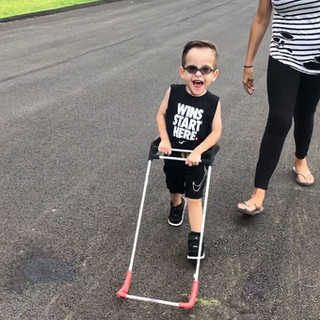
A gait belt gives an adult a way to steady or assist a child. A mobility cane gives the child touch information about the path ahead. A child with both a motor impairment and a visual impairment that affects mobility may need both kinds of support.

When I watch a child move, I ask two questions. What helps this child stay upright and move? How does this child find out what’s ahead before taking the next step? The answers help me understand what kind of support to try.
What each tool helps your child do
What your child needs | What can help |
Physical help to stand, balance, walk, or get around | A gait belt, gait trainer, walker, or wheelchair may meet different physical mobility needs. A pediatric physical therapist can help assess which support fits your child. |
Information about obstacles or changes in the surface ahead | A mobility cane extends the child’s sense of touch. The Pediatric or Big-kid Belt Cane uses a fitted belt to hold the cane frame in position so the tips can contact the path ahead. |
Both physical support and information about the path | A child may use a physical mobility device and a Belt Cane together. An orientation and mobility specialist and a physical therapist can assess how the supports work together for that child. |
What you might notice at home
I use the term mobility visual impairment or blindness (MVI/B) when a child’s vision is too unreliable for self-reliant movement. Watch how your child moves through an everyday space, such as the living room or hallway. Do they avoid crossing the room? When they do cross it, do they walk with their feet wide apart, stumble, or lose their balance? Do they discover a threshold or an object only when their foot hits it?
A child can see clearly in one part of their visual field and still miss important information while walking. For example, a child with a lower visual field impairment may see you across the room and miss the step down between you. Some children begin to avoid moving after repeated falls. Others keep going and come home with bruises and scrapes. Tell the evaluation team what your child missed and what happened next. That detail helps them understand what your child can see while moving.
Remi took more steps on her first day
Remi was 23 months old and blind. She could walk, but she took short, slow steps. In the side-by-side video from her first Belt Cane trial, she uses a handheld rectangular cane in one clip and a Pediatric Belt Cane in the other.
With the handheld frame, Remi sat down. With the Belt Cane, she found a clear path, took many more steps, and stayed on her feet. Watch what she’s doing as she goes. She’s walking and talking. For me, the comparison shows why it’s worth trying a mobility tool while a child is still learning to walk. The information the tool provides can change what the child is able to practice.
Jazin used the wall contact to decide when to turn
Jazin has cerebral palsy and a visual impairment. His gait trainer provided physical support for moving. His mother explained that before he had the Belt Cane, he had difficulty navigating around objects. With the Belt Cane, contact with a wall gave him information he could use. If the cane frame touched the wall on his right, he could tell he had gone too far in that direction and adjust.
That moment shows why a child may need both devices. The gait trainer supported Jazin’s movement. The cane frame gave him a cue he could use to decide where to go.
Why I recommend asking early
The CDC lists walking without holding on as a milestone most children reach by 18 months. Walking opens up new opportunities to explore, approach other people, and learn words in context. A child who can walk over to the laundry basket can feel what’s inside, pull a sock out, and hear someone name what they found. Research has also found an association between the onset of walking and gains in language comprehension and use. CDC
If your child with a mobility visual impairment or blindness (MVI/B) misses obstacles or changes in the walking surface, ask for an orientation and mobility (O&M) evaluation while they’re learning to walk. If your child with an MVI/B already works with a physical therapist, you can start the conversation this way.
“Have you heard of the Pediatric and Big-Kid Belt Cane? I’d like my child to try it. Can we work with an orientation and mobility specialist to see what helps my child move and find the path ahead?”
During a fitted trial, watch how your MVI/B child stands, walks, and chooses to move. Do they take more steps, stay active longer, or seem happier while walking? When the cane frame tips contact something, do they pause, turn, or take another route? Those are concrete observations you can share with the team as you decide what support your child needs


Comments