


Safe Toddles Is Now an ACVREP RPPLE Provider: Earn CEUs While Learning the Future of Mobility for Blind Children
- Grace Ambrose-Zaken
- Mar 7
- 3 min read
We are proud to announce that Safe Toddles is now an approved provider of continuing education through the Academy for Certification of Vision Rehabilitation & Education Professionals (ACVREP) RPPLE program.
This means professionals certified through ACVREP—including orientation and mobility specialists, teachers of learners with a visual impairment, and early intervention professionals—can now earn CEUs toward recertification while learning groundbreaking methods of the Blind Baby Safe Mobility instructional materials that have forever changed mobility outcomes in learners with a mobility visual impairment or blindness (MVI/B) across the age spectrum for the better.

Professionals can view and enroll in Safe Toddles CEU courses here:
A New Era in Mobility for Learners with an MVI/B
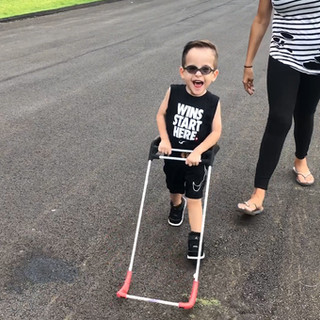
Until the innovation of the Pediatric Belt Cane, children with an MVI/B have been unable to avoid significant impairments in independent walking and movement. Long cane instruction begins after a child with an MVI/B demonstrates the ability to walk and grasp a cane, leaving a critical developmental window unsupported.
Safe Toddles educational programming addresses this gap, at every age in our Blind Baby Safe Mobility curriculum. Our training focuses on assessment and teaching strategies for children with an MVI/B wearing the Pediatric Belt Cane, the only white cane mobility tool recognized as a walking solution.

The results are extraordinary.
With proper implementation:
Toddlers with an MVI/B walk on time
2-year-olds with an MVI/B easily let go of the wall to achieve 7 plus hours of independent, purposeful walking activity per day
Older children with an MVI/B let go of their caregivers and experience greater confidence, exploration, and joy in movement
This represents a fundamental shift in what professionals in the field of blindness and low vision believed was possible (just read their textbooks).
What Makes Safe Toddles Education Unique
Safe Toddles courses provide research-based, practice-ready instruction that professionals can immediately apply in clinical, school, and early intervention settings.
Participants learn how to:
Assess children with an MVI/B motor and physical activity delays
Understand how sensory feedback supports balance and bipedal walking
Integrate the Pediatric Belt Cane into orientation and mobility instruction
Support infants and toddlers in achieving sustained independent movement through wearing their Belt Cane during their daily activities of living
Increase balanced, protected, and informed exploration
Improve developmental outcomes through consistently supporting a child with an MVI/B's daily mobility through commonsense, research-based methods
Our curriculum is built on the principle that balanced, safe and informed mobility drives all development. When children with an MVI/B can easily move independently, they learn more about their bodies, their environments, and their capabilities.

The Walking Solution
The Pediatric Belt Cane provides children with three essential elements for safe movement:
Balance
Protection
Environmental information
A key feature of the Belt Cane is its extended touch feedback, which provides a measurable balance advantage for children with MVI/B. Because touch functions as the dominant sensory channel for spatial awareness in children with an MVI/B, extending tactile feedback beyond the child’s body allows them to detect environmental information earlier and more consistently.
This continuous tactile input supports:
postural stability
orientation to space
anticipatory movement
confident bipedal walking
For this reason, the Belt Cane is most effective when worn during the majority of daily activities of living. Consistent use ensures that children receive the ongoing tactile information necessary to safely explore their environments and remain physically active throughout the day.
The Belt Cane also functions as a protective spatial buffer, extending the child’s awareness approximately two steps ahead of their body. This advance detection creates a protective “bubble” that helps prevent collisions with obstacles and people while allowing the child to approach others at a more natural social distance.
This combination of balance support, environmental information, and protective distance enables children with MVI/B to move more freely and safely while developing essential social interaction skills, language, and environmental concepts.
When incorporated consistently into daily routines and mobility instruction, the Pediatric Belt Cane supports a major shift in developmental outcomes: MVI/B toddlers walking on time and children with an MVI/B sustaining hours of joyful, independent movement each day.
Earn CEUs and Transform Your Practice
Safe Toddles courses are designed for professionals who want both:
CEUs toward ACVREP recertification
Practical knowledge that directly improves outcomes for MVI/B children
Participants will gain the assessment skills, teaching strategies, and clinical insight needed to confidently include the Pediatric Belt Cane within:
Orientation & Mobility practice
Early intervention services
School-based visual impairment programs
Rehabilitation services
Join the Movement
The field of blindness and low vision is entering a new phase—one where early independent mobility is not delayed, but expected.
Safe Toddles is honored to support professionals who want to lead that change.
Stay tuned for upcoming course announcements and enrollment opportunities.
Together, we can ensure that blind children experience the freedom, confidence, and developmental benefits of walking early and walking often.
Learn more at: https://safetoddles.podia.com/products


Comments