


White Cane Soccer: Let the Whole Blind Child Play
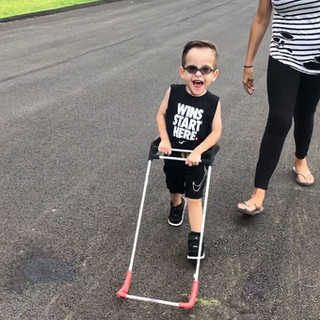
What happens when we bring together a Pediatric Belt Cane, a beeper ball, and a young child’s desire to move? We create an opportunity to learn through play.
Soccer can start long before the soccer field
When we think about soccer, we picture children running across a field, chasing a ball, and kicking it toward a goal. But what about a toddler who is blind or has a mobility visual impairment?
That child may be eager to move, reach, explore, and play. Yet a ball that rolls silently out of reach, an unfamiliar space, or an unexpected obstacle can make participation difficult.
The answer is not to wait until the child is older or can play soccer in a conventional way. We can adapt the activity to make the environment more accessible while allowing the child to take an active role.
That is the idea behind White Cane Soccer with a Pediatric Belt Cane, featured in the Blind Baby Safe Mobility Curriculum from Safe Toddles.
Why call it White Cane Soccer?
The adult long cane provides information about the space ahead through touch. The Pediatric Belt Cane builds on that principle for young children who are learning to walk and move through their environments.
The wearable belt holds the cane frame in position, helping reduce the burden of tracking a handheld cane. As the child moves, the frame provides extended touch information about the space ahead and can help detect obstacles before the MVI/B child reaches them.
In White Cane Soccer, the child wears the Belt Cane and uses the cane frame to contact and push a ball. A continuously audible beeper ball provides an additional source of information, helping the child locate and follow the ball.
Touch and sound work together. The ball makes noise, while the Belt Cane provides information about the space between the child and what lies ahead.
The child is not simply being guided toward a ball. The child is learning to move, make contact, and act on information from the environment.
How to introduce Belt Cane Soccer
The goal is meaningful participation, not competition. Begin with a simple activity and let the child learn through repeated opportunities to move and explore.
1. Get familiar with the ball
Introduce a ball that makes a continuous sound. Give the child time to locate it, reach toward it, touch it, and explore how it feels and sounds.
Children can also experiment with balls of different sizes and textures. Picking up, carrying, pushing, banging, and throwing balls are all worthwhile ways to build familiarity before introducing a more structured game.
2. Explore the ball with the Belt Cane
With the Belt Cane fitted appropriately and the child positioned safely, encourage the child to move the cane frame toward the audible ball.
The MVI/B child can practice making contact with the ball and pushing it with the frame. The ball may move away, change direction, or make a different sound as it travels.
Give the child with an MVI/B time to discover these relationships. Avoid routinely moving the child’s body or directing every movement. Allow the MVI/B child to initiate actions, try again, and discover what works.
3. Introduce a short-tethered ball
For an MVI/B child who is just learning to connect the cane frame with the ball, a tethered-ball activity may provide a useful introduction.
A short tether can help keep the ball within a more predictable area, giving the child repeated opportunities to contact the ball and experience the relationship between movement and ball feedback. This introductory activity is not intended for running or multiplayer play.
As the MVI/B child becomes familiar with the activity, the goal is to create opportunities to engage with a freely moving ball.

4. Make the playing area understandable
Use clearly detectable, padded boundaries to help define the playing space. A distinctive sound at the goal can provide an auditory target.
Keep the initial area simple and manageable. Make sure the child with an MVI/B has room to move without encountering hard obstacles or other players unexpectedly.
The setup should be adapted to the child’s mobility, motor abilities, and experience. Safety comes first, and adult supervision remains essential.
5. Let the child play
Once the child with an MVI/B understands the basic activity, allow time for experimentation.
The MVI/B child might push the ball away, follow its sound, change direction, or try to make contact again. These actions create opportunities to practice movement, spatial concepts, sound localization, and purposeful travel.
Sighted adults can participate in complementary roles, but they should not routinely take over the MVI/B child’s movement or direct every action. The purpose is to make participation possible while preserving the MVI/B child’s opportunity to initiate and act independently.
More than a game
Ball play offers opportunities to practice skills that matter well beyond the playing area.
Motor skills: walking, reaching, pushing, turning, and coordinating movements.
Language: learning words such as ball, push, stop, go, near, far, and goal.
Concept development: exploring movement, direction, distance, contact, and cause and effect.
Auditory attention: locating a sound and noticing how it changes as the ball moves.
Social participation: taking turns, sharing space, and participating alongside other children.
Self-reliance: initiating movement, making choices, and learning through personal experience.
These are opportunities for learning, not automatic outcomes. Adults can observe what the child does, identify emerging skills, and adapt the activity to support the child’s next steps.
Why start so young?
Mobility learning does not begin when an MVI/B child is "ready" to use an adult long cane or participate in organized sports.
It begins when an MVI/B child starts reaching toward something interesting, moving toward a familiar voice, exploring a room, or taking early steps toward a desired object.
Children with an MVI/B need access to information about the space around them, along with opportunities to practice using that information. Waiting until adult mobility tools or activities become appropriate can mean missing valuable opportunities for early learning.
At Safe Toddles, we believe safety and self-reliance belong together. MVI/B children need protection that makes exploration possible, along with opportunities to take an active role in their own movement.
White Cane Soccer is one way to bring that principle into play.

Explore the Blind Baby Safe Mobility Curriculum
White Cane Soccer is part of a larger approach to early mobility education: giving families and professionals practical ways to help young children with an MVI/B learn through everyday activities.
The Blind Baby Safe Mobility Curriculum connects movement with motor development, language, concepts, and social participation. It helps adults create opportunities for children with a mobility visual impairment or blindness (MVI/B) to explore their environments and develop safe, self-reliant mobility from the earliest stages of walking.
Because the goal is not simply to help MVI/B children walk. It is to equip them to get where they want to go.
Explore the Blind Baby Safe Mobility Curriculum: https://safetoddles.podia.com/
Safe, self-reliant mobility starts long before the soccer field.
Dr. Grace Ambrose-Zaken, Ed.D., O&M Professor (retired)
Co-Founder, President & CEO, Safe Toddles


Comments