


Why the Cane Frame Needs to Be Obvious
Updated: Sep 10

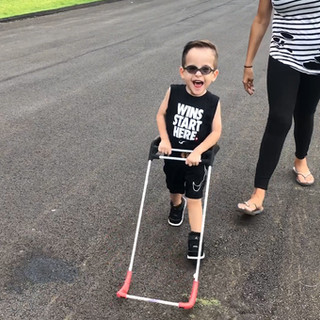
A blind child’s mobility tool is bright white and red, extends well into the path, and boldly protects the space needed by that blind child for his next step. This is a good thing.
Join our See My Cane Frame campaign. Where we celebrate the boldness of blind children's mobility tools. The big white cane frame is a signal that needs to be obvious- because the adults around the child need to know that the child cannot see and they should help accordingly.
The cane frame is meant to be seen. Its visibility is part of how it works.
The cane frame's visibility is part of how it works.
The Cane Frame Goes First
When a child with a mobility visual impairment or blindness (MVI/B) moves through the world, the first contact should not be their body. The first contact should be the sturdy mobility tool, built for collisions of all kinds. A Pediatric or Big-kid Belt Cane surrounds the MVI/B child with a lightweight cane frame that reaches the world before the child’s forehead, chest, hands, knees, or toes do.
If the way is clear, the child with an MVI/B can keep moving. If the way is blocked, the cane frame stops them. As the MVI/B child learns to interpret touch feedback, their next step becomes clearer. The MVI/B child’s body is no longer the bumper, they learn to enjoy independence.
A cane frame bump is better than a body bump.
Personal Space for Conversation and Play
The cane frame preserves the blind child's personal space. About 1.5 feet of space is considered the distance for everyday social interactions. For a child with an MVI/B, the cane frame makes it easier to maintain that 1.5 feet of space between their friends and adults.
The Belt Cane claims the path ahead for the child. When people can see the frame, they can recognize that they should avoid the space claimed by the cane frame for that the MVI/B child’s next step. That matters because MVI/B children should not have to absorb the impact of other people’s inattention. The cane frame gives other people a visible cue:
It says "make room, notice respectfully, and let this MVI/B child move".
Pride Belongs Here
The See My Cane Frame campaign says See the big white and red cane frame as a badge of honor for the MVI/B child: Wearing their Belt Cane they are able to locate the clear path independently. It can also be a badge of advocacy for the family: They are proud to give their MVI/B child the tools that allow their movement to be more self-reliant and self-directed.
The goal is to make the world recognize, respect, and welcome the increased size and place these children need to move about. They need that extended touch to be self-reliant travelers.
Watch What Changes
This campaign is built on real footage of MVI/B children before and while wearing Pediatric and Big-kid Belt Canes. Again and again, the videos show the same pattern: the cane frame reaches first, the MVI/B child receives clearer tactile feedback, and movement changes.
MVI/B children wearing the Belt Cane move with more confidence. Adults hover less as their next step becomes more certain.
When the tool is visible, access is visible. Safety is visible. Confidence is visible. Pride is visible.
Join the See My Cane Frame Campaign
We are asking families, educators, therapists, doctors, school leaders, neighbors, and community members to help spread the word. Share the campaign page. Share the videos. Start conversations with the people who need to understand that obvious mobility tools are not something to pity or minimize. They are part of access, safety, personal space, independence, and pride.


Comments