


Why Belt Canes Instead of Handheld Canes for Young Blind Children?
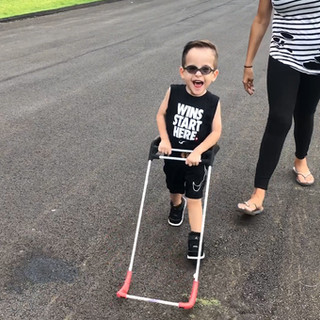
Parents often hear that a child with a mobility visual impairment or blindness (MVI/B) should learn to walk first and learn formal cane skills later. But for a young child who cannot see what is ahead, walking and mobility are happening at the same time. This post explains why early tactile information matters, where handheld cane learning can create a developmental mismatch, and how the Belt Cane can give families another option during the earliest stages of independent movement.
Key takeaway: An MVI/B child does not need to wait until they can consistently use a handheld cane before receiving tactile information for walking. The Belt Cane is designed to provide body-centered tactile feedback earlier, while the child is still developing balance, confidence, and independent exploration.
Why wait for a young MVI/B child to master a handheld mobility device before giving them the tactile information they need to move independently?
For parents of a young child with an MVI/B, learning to walk can be an exciting—and confusing—time.
Around 11 months, a baby may be pulling to stand, cruising furniture, taking steps, and making tremendous progress through physical therapy and daily encouragement. By 15 months, many children are walking.
But there is an important difference between learning to walk and learning to walk without vision.
A sighted child uses vision to constantly gather information about what is ahead: a toy, a wall, a step, a person, or an open pathway. That visual information helps the child balance, anticipate what is coming, and adjust their movement.
An MVI/B child cannot use vision in the same way.
For a blind child, touch becomes an essential source of information for balance, orientation, protection, and exploration.
And that raises an important question:
Why should a young MVI/B child have to wait until they can master a handheld mobility device before receiving meaningful tactile information while they walk?
Why handheld cane skills take time
A long cane is a valuable mobility tool. But using one effectively is not simply a matter of putting a cane into a child's hand.
A young child has to learn a series of coordinated skills before the handheld cane can consistently provide the information it is designed to provide.
These include:
Holding the cane correctly — four fingers around the handle with the index finger pointing downward.
Extending and centering the arm along the body's midline.
Positioning the hand correctly, with the back of the hand facing outward.
Moving the cane with the wrist, using a back-and-forth hinge-like movement.
Coordinating the cane with every step — one swipe for each step, consistently and without verbal prompting.

These skills don't just need to be learned. They need to become increasingly automatic.
That creates a developmental challenge.
A young child is already learning how to stand, balance, take steps, change direction, recover from losing balance, and explore the environment.
The handheld cane adds another complex motor task:
The child must learn to control the tool while simultaneously learning to move their body.
Why timing matters for early tactile feedback
The child needs tactile information while learning to walk.
But the handheld device requires the child to develop specific skills before they can use it consistently as intended.
The difference is not whether children need mobility skills. They do. The difference is whether the tool begins giving useful tactile information before—or only after—the child can coordinate several handheld cane skills at once.
Handheld mobility tool | Belt Cane |
Requires active hand use. | Secured to the child's body. |
Requires specific hand and arm positioning. | Does not depend on a handheld grip. |
Requires coordinated cane movement. | Cane frame moves with the child. |
Requires the child to sweep with each step. | Provides body-centered tactile contact. |
Skills must become increasingly automatic. | Begins providing tactile feedback when fastened. |
Adult prompting may be needed while skills develop. | Designed to support self-initiated movement. |
Can be taught as a specific mobility technique. | Can be incorporated into everyday movement. |
The Belt Cane does not eliminate the need to learn mobility skills.
It changes when the child can begin receiving tactile mobility information.
What can happen without early tactile information?
Parents sometimes see something surprising.
Their child is physically capable of walking.
They may walk across the living room. They may take steps between familiar people and furniture. They may look like they are doing well.
But as the environment becomes less predictable, walking can become harder.
A blind child cannot see what is in their path.
They cannot visually anticipate the next obstacle or change in the walking surface.
So instead of becoming more confident as they walk more—as sighted toddlers often do—they may become more cautious.
They may walk slowly.
They may stop exploring.
And they may begin reaching for a parent's hand.
For some families, this becomes a frustrating cycle:
The child can walk, but doesn't feel confident walking independently.
The parent provides the protection and information the child needs.
The child holds the parent's hand.
And the more the child relies on that helping hand, the harder it can become to let go.

What early tactile feedback can change
The Belt Cane starts from a different premise:
Don't wait for the child to master the mobility tool. Give the child tactile mobility information while they are learning to move.
The Belt Cane is fastened around the child's body.
Once it is secured, the cane frame is positioned with the child's body and is ready to provide tactile feedback as the child moves.
The child does not have to:
remember to pick up the cane,
maintain a particular grip,
keep an arm extended,
coordinate a wrist movement,
sweep the cane with each step,
or respond to continual verbal reminders to use the cane.
The Belt Cane stays with the child.
As the child walks, turns, explores, and encounters changes in the environment, the cane frame provides extended touch feedback through a body-centered connection.
This allows tactile information to become part of the child's movement experience from the beginning.
How the Belt Cane fits with long cane learning
Yes.
The goal of the Belt Cane is to encourage a child in learning to use a handheld cane.
The goal is to give a young child an easier way to develop independent movement- the mobility tool is just a sensory detector, the easier it is the more independent an MVI/B child can move.
An MVI/B child can learn different mobility tools as it makes sense for the child's motor and intellectual characteristics.
The Belt Cane can provide early body-centered tactile feedback while a child is developing foundational walking and mobility skills.
As the child develops, they can also learn handheld cane techniques.
One does not have to exclude the other.
The question is not:
"Should my child use a Belt Cane OR a long cane?"
A better question is:
"What mobility support does my child need right now, at this stage of development?"

Why starting earlier matters
Early walking is not simply about reaching a developmental milestone.
It is when children are learning how to move through the world.
They are learning to:
balance while moving,
recover from losing balance,
change direction,
explore unfamiliar spaces,
respond to changes in the environment,
move toward something they want,
and initiate movement without waiting for another person.
For a blind child, tactile information is part of that learning process.
The goal isn't simply to get a child walking. The goal is to help the child learn to walk independently.
That is why we believe parents should learn about the Belt Cane early.
Our youngest Belt Cane user to date was 11 months old this demonstrates something important:
Mobility support does not have to wait until a young blind child has mastered a handheld cane.
Don’t wait for independence to teach independence
It is understandable for a parent to think:
"First my child needs to learn to walk. Then we'll teach them to use a cane."
For a blind child, however, walking and mobility cannot always be separated.
A child who cannot see what is ahead needs a way to receive information about the environment while they are learning to walk.
The Belt Cane is designed to provide that information without requiring a young child to first master a complex handheld technique.
It stays with the child.
It moves with the child.
It provides extended tactile feedback as the child explores.
And it gives parents another option for supporting independent movement during the critical period when their child is learning to walk.
Don't wait for a child to master a mobility tool before giving them the mobility information they need.
If your MVI/B child is beginning to pull to stand, cruise, walk, or explore independently, ask your child’s mobility and developmental team whether early body-centered tactile feedback could support the next stage of movement.
Learning about the Belt Cane early can help you make informed choices before cautious walking becomes dependence on a guiding hand.


Comments