


What Is the Goal of the Push Toy for MVI/B Toddlers?
Updated: Jul 24
When you hand a push toy to a toddler, you’re not just giving them something to hold—you’re shaping how they learn to move through the world. The real question is whether the goal of a push toy for a toddler with a mobility visual impairment or blindness (MVI/B) is (or should be) the same as it is for a sighted child.
The Goal for Sighted Toddlers
For sighted toddlers, push toys serve a clear and temporary purpose. They help bridge the gap between standing and confident walking. Once that milestone is reached, the toy evolves into something else—imaginative play like “shopping” or pushing a stroller—and is eventually outgrown altogether.
In other words, the push toy is transitional. Sight takes over as the primary system for balance, protection, and navigation.

What Changes for MVI/B Toddlers?
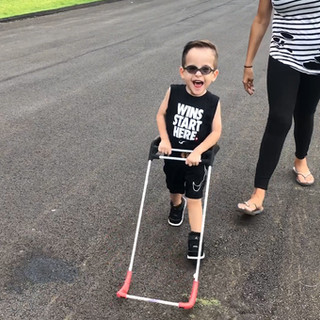
Now consider a blind 3-year-old being given a toy shopping cart—not for play, but simply to encourage stepping.
At first glance, it might seem like a reasonable adaptation. But it raises a deeper issue: what is the long-term goal of mobility for that child?
If the tool being used doesn’t translate into real-world, functional mobility, then it’s not just a neutral choice—it may be a limiting one.
The Real Purpose Behind the Push Toy
For toddlers with an MVI/B, the push toy is often used to achieve one thing: separation from physical support like a caregiver’s hand or the couch. It introduces distance and encourages independent steps by shifting reliance toward extended touch.
That’s a step in the right direction—but only partially.
Because unlike sighted children, blind children don’t “graduate” to vision. Their dominant sense for movement and safety will always be touch.
So the real question becomes:
Is the push toy building a system the child can use everywhere, or just in the living room?

Where Push Toys Fall Short
Push toys were never designed as mobility tools. And when you look at them through that lens, the limitations are obvious:
They don’t travel well (try fitting one in a car or airplane)
They don’t function in real environments (grass, gravel, uneven terrain)
They’re difficult to steer and control
They don’t fit into daily life (classrooms, tight spaces)
They offer no practical strategy for stairs
Stair navigation alone exposes a critical gap. Stairs are typically introduced around 21 months for sighted children. A MVI/B 2-year-old children need a reliable method for detecting and managing stairs safely—not a bulky toy that can’t realistically be used on them.

Let Toys Be Toys
Here’s the piece that often gets overlooked: a push toy should remain a toy for a blind child, too.
Children with an MVI/B deserve access to play for its own sake—not just as a workaround for mobility. When a push toy becomes a primary walking tool, it stops being a source of imagination and starts becoming a substitute for something it was never designed to be.
That tradeoff matters.
If a child already has access to a functional mobility system—like the Pediatric Belt Cane—then the push toy can stay where it belongs: in play.
Let it be a shopping cart during pretend play
Let it be something they choose, not something they depend on
Let it support development socially and imaginatively, not functionally
Mobility and play should not compete with each other. When mobility is handled effectively, play is freed up to be what it should be.
The Bigger Issue: Skill vs. Tool
Mobility is not just about taking steps. It’s about independent, repeatable, real-world navigation.
A push toy may help initiate walking, but it does not teach:
Environmental awareness
Obstacle detection
Spatial understanding
Safe movement across varied settings
And most importantly, it’s not something the child can or should use all the time.

What Should the Goal Be?
For a child with an MVI/B, the goal of any mobility tool should be simple and uncompromising:
Use it every time you are moving through a world you cannot see.
That standard immediately disqualifies the push toy as a long-term solution.
A More Functional Approach
Instead of relying on a toy designed for short-term use, MVI/B children benefit from tools that align with how they naturally gather information—through touch.
A wearable mobility tool, such as the Pediatric Belt Cane, introduces extended touch feedback. This allows the child to:
Maintain balance through continuous tactile input
Detect obstacles before contact
Move confidently across environments
Navigate spaces like classrooms, sidewalks, and stairs
Unlike a push toy, it’s not something the child outgrows—it’s something they build upon.

The Bottom Line
A push toy has a place—but it’s a narrow one. For sighted toddlers, it’s a short developmental phase. For blind toddlers, using it beyond that early window (around 10–12 months) risks reinforcing a tool that doesn’t translate to real life.
Let the push toy stay a toy. Let mobility be something stronger, more consistent, and truly functional. If the goal is true independence, then every mobility decision should point toward a system the child can rely on everywhere—not just at home, not just on smooth floors, and not just for a few months.
Because mobility isn’t about taking steps.
It’s about knowing where those steps can take you.


Comments