


A Person, a Dog, or a Long Cane: Why Blind Mobility Needs a New Generation of Tools to Choose From
We Have Entered the Age of Rapid Prototyping. Users of Blind Mobility Tool Design are Benefiting Like Never Before

Consider how quickly technology has changed the way people interact with the world. A 3D printer can turn an idea into a physical prototype in hours. Lightweight materials can be designed, tested, modified, and redesigned.
Medical Device Engineers are using technology to improve our lives using interfaces, materials, and mechanical systems that would have been impractical or prohibitively expensive to produce just a few decades ago.
Until 2017, when it came to mobility tools for blindness, the basic choices had gone unchanged for decades. The dog guide (1932) and long cane (1945) were important mobility innovations in their day. The long cane was invented by "the greatest generation" in 1945 after WWII for blinded vets.
The mobility tool choices are:
A guide (used by blind people of all ages).
A dog guide (limited to blind adult use only).
A long cane (open to all, but in all studies on people using the long cane correctly included only graduate students wearing blindfolds). In fact actual published studies showed blind high school children failed to correctly use a long cane after a year of daily O&M instruction.

Why aren't blind kids allowed to use long canes inside their classrooms?
and now
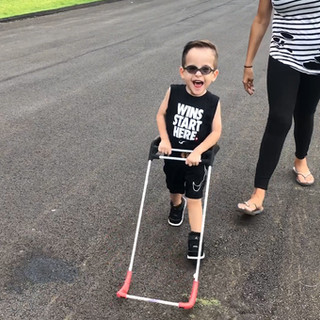
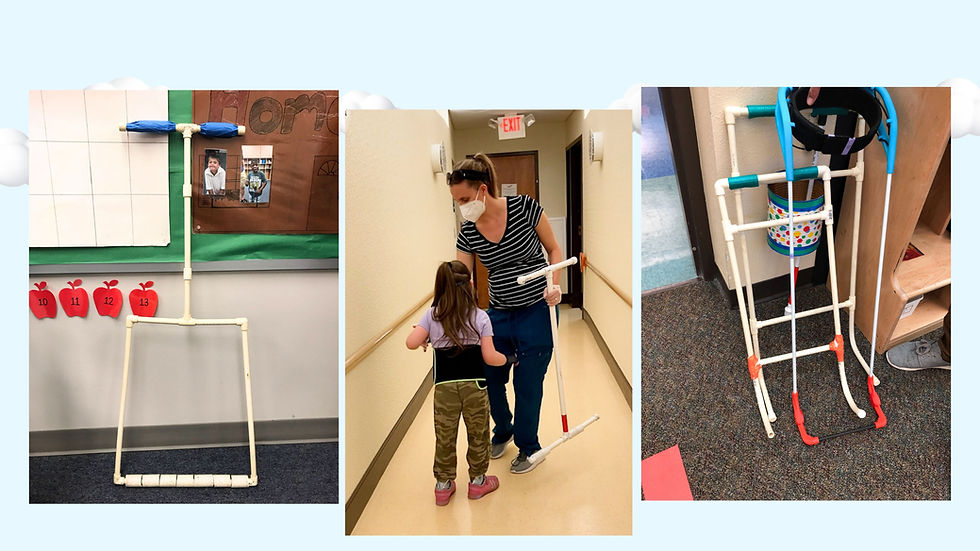
A Belt Cane published research studies include hundreds of actual blind children benefiting from wearing pediatric and big-kid belt canes.
The first 3D printed wearable cane prototype was invented in 2017, since then it has been used successfully by thousands of children with a mobility visual impairment or blindness (MVI/B) in 48 countries around the world.

Now we seek to ask the question again What else could we build?
And perhaps an even more important question: What mobility tools could we build specifically for the child born an MVI/B who wants to be included in sports, leisure and all the recreation fun WITH their mobility tools -ones built for maximum performance and vitality.
The Three Historic Models of Blind Mobility
For generations, blind mobility has largely been organized around three fundamental models.
1. Someone else guides you.
A parent, teacher, aide, or other sighted person can provide physical guidance and environmental information. The child follows a person who can see what is ahead.
For a child with an MVI/B, this can be essential. A human guide can provide immediate protection, direction, reassurance, and information about the environment.
For a child with an MVI/B, this can also be quite limiting. Having to wait for a guide to go places is counter to common understanding of how children learn, play and enjoy life.
Children learn by doing, going. How can a child learn to wait for an adult at the curb, if you are already holding an adults hand just to get to the curb?
Sighted children learn untethered from adults.

2. A dog guides you.
In 1932. the guide dog transformed independent mobility for many blind adults. As is stated in this 1963 joint statement signed by the leaders of the field, blind children have to be at least 16 years old before considering a dog guide. The truth is that no dog guides are found inside high schools and less than 3% of the population of adults with an MVI/B use a guide dog.

3. A long cane.
In 1945, the long cane introduced another important shift: the blind person can gather information independently through extending their reach onto the surface ahead.
The cane extends touch beyond the body and allows a skilled user to detect changes in the walking surface and obstacles in the path as they move by swinging the cane tip back and for with each step.
For someone who has developed the necessary skills, the long cane can become an extremely effective mobility tool, but it is not included in sports.

But while the long cane arc is effective for walking on sidewalks and down hallways, it's shape is not effective on any playing field. The long cane requires complex motor skills that compete with other sport and leisure motor skills that might be more fun. So, in order to be included in sport, blind children are told to play without their mobility tool.
But falling over your friends simply because you have no way to detect or avoid them...can't be that fun after the first time...
can it be fun -or can't fun be less harmful even though you are blind/blindfolded?

To date, instead of providing an alternative mobility device for blind children, they have just been told to play running and ball sports blind.
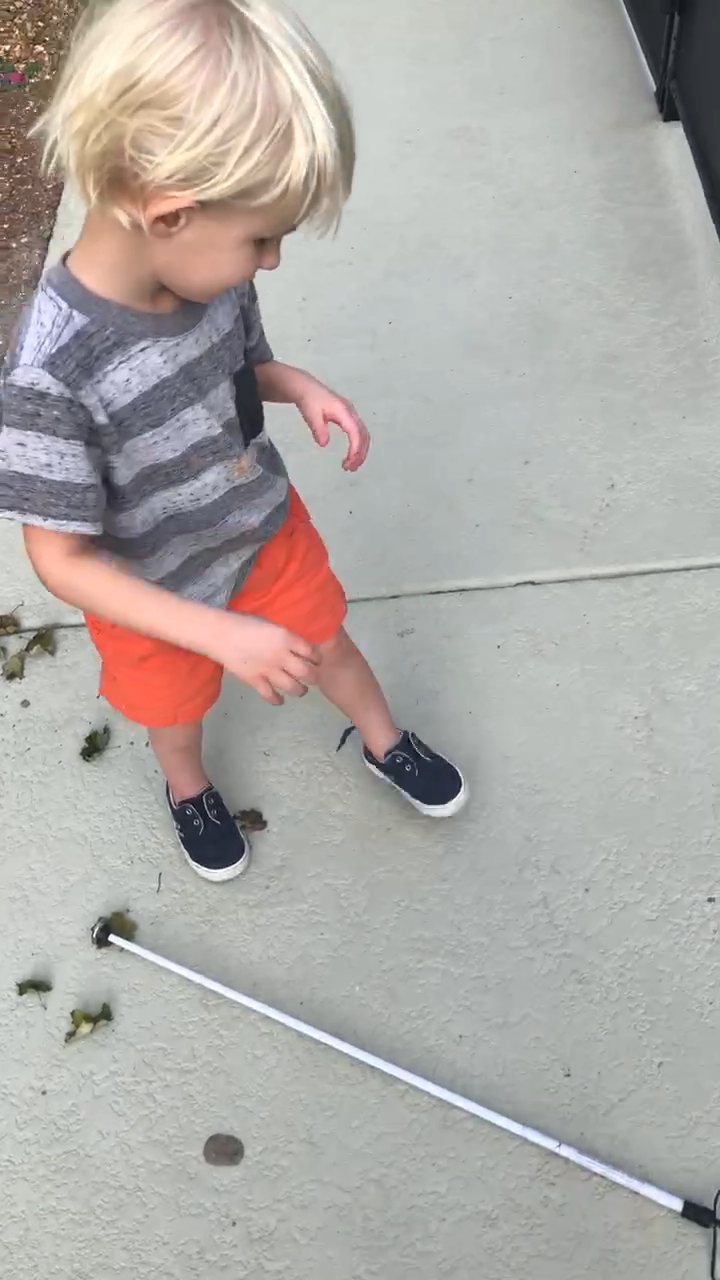
For a infant born blind, as a toddler who is just learning to walk, a preschooler delayed in walking, an elementary student struggling to use a long cane, a teenager with intellectual and motor impairments—those shown again and again unable to master the long cane arc for daily activities of living. We ask How come poor cane skills are their fault - why are blind school aged children offered no other mobility choice to fill in for them...until such time as they can master the long cane?
How come poor cane skills are their fault?
And this is where we should pause.
What if the limitation isn't the blind child's?
What if we have simply been asking the MVI/B child to adapt to a mobility technology that was never designed around a child's developmental abilities?

What If We Started With the Child?
This is where a fourth model becomes possible.
Instead of beginning with the assumption that a blind person must possess a set of skills to acquire the safety of a mobility tool. We started with the belief that every blind person should have easy access to a mobility tool's extended touch feedback, not just during school, but as part of their fun and play with others.
We began with the needs of the blind person who is actually moving.
We started with accepting the child's natural developmental abilities.
We continued with the fundamental information that an MVI/B child loves to move and participate independently.
We recognized that movement without anticipatory control is unnecessary with the proper device.
And then we asked: What kind of mobility technology could provide that information without requiring the MVI/B child to become an expert user of the technology first?
That is a fundamentally different design question.
The Fourth Model: Mobility Technology That's Built With You in Mind
The fourth model is person-centered mobility technology.
Instead of putting the technology in the person's hand and asking the person to learn how to operate it, the mobility tool becomes part of the person's movement.
It moves with the body.
It stays with the person.
It can provide information as the person thinks about something else such as moving quickly over complex terrain while trying to score a goal.

This opens up possibilities that are difficult to achieve when mobility depends on a handheld device.
What if a mobility device did not have to be held in the hand at all?
What if protection could move with the MVI/B child?
What if environmental information could be available continuously rather than only when a child with an MVI/B successfully performs the required cane technique?
What if an MVI/B child could have both hands available to play, reach, touch, hold, climb, kick, explore, and interact with other people while still receiving useful information about the space immediately ahead?
What if mobility technology could be designed around the way a child with an MVI/B naturally moves rather than requiring the child to change how they move in order to use the technology?
This is the idea behind the Pediatric and Big-kid Belt Canes.
They represent a different starting point—not a replacement for every other mobility option, but a fourth way of thinking about how mobility technology can connect a person to the environment.
Instead of asking the child to hold on to a guide, wait for a guide dog, or wait to succeed at a long cane, the wearable mobility tool becomes connected to the child's movement.
The tool moves because the MVI/B child moves.
And that changes the design problem.
The question is no longer simply:
“How can we teach a child to use the mobility technology we already have?”
It becomes:
“What mobility technology can we create for the way this MVI/B child actually learns to move?”
We Don't Need to Stop at Three
The goal isn't to erase the technologies that came before.
Human guides remain valuable. Guide dogs remain an important mobility option for adults. Long canes remain an essential tool for many blind working adults.
But important technologies do not have to become the boundaries of our imagination.
The history of technology is filled with moments when someone looked at an established solution and asked a deceptively simple question: What if we did this differently?
Blind mobility deserves that question, too.
We now have the materials, manufacturing technologies, engineering tools, and knowledge of human movement to explore mobility solutions that were difficult to imagine—or difficult to build—generations ago.
So perhaps the next generation of blind mobility shouldn't be about choosing between a person, a dog, or a long cane.
Perhaps it should be about creating more choices. Because the future of blind mobility should not be limited by the tools that were invented before today's children's great-grandparents were born.
We can build new things.

Comments