


The True Cost of Waiting: What Happens When a Blind Baby Has No Mobility Tool?
Updated: Sep 19
The first article in “The Cost of Waiting,” a series examining what happens when we fail to invest in appropriate mobility technology for young children with a mobility visual impairment or blindness.
The question we should be asking much earlier when a baby is diagnosed with a mobility visual impairment or blindness (MVI/B) is:
What will this child use to move safely and independently while learning to stand and walk?
Too often, the answer is essentially: nothing yet.
And, everyone waits.
We wait for the child with an MVI/B to walk.
We wait for the child with an MVI/B to become more coordinated.
We wait until the child with an MVI/B is “old enough.”
We wait until the child with an MVI/B can supposedly understand a conventional cane.
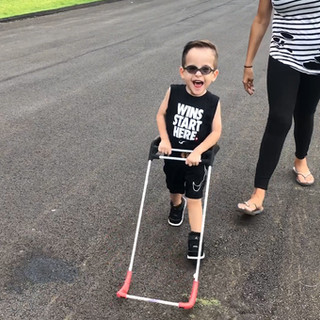
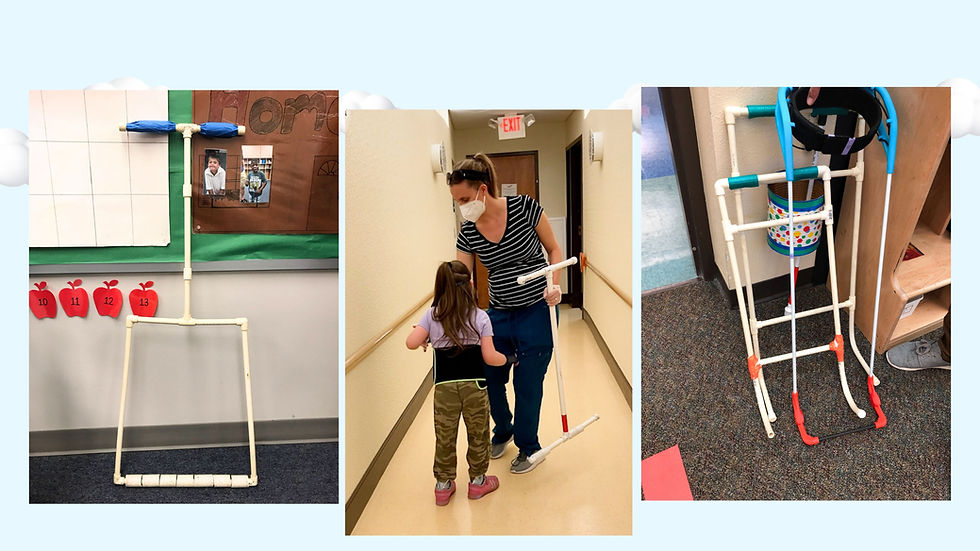
And when a child cannot safely navigate without assistance, professionals and families may turn to whatever can be built from materials that are readily available—PVC pipe, wheels, handles, frames, and other components—to create an adaptive mobility device (AMD).
That ingenuity deserves recognition.
But it also tells us something important:
We have been trying to solve a problem at Home Depot that the marketplace has largely failed to adopt the child-size AMD.
The problem can't be that the child with an MVI/B isn't ready.
Everybody encourages babies to stand and take steps before they are “ready for independent walking” allowing them to feel walking.
The walking itself is part of how the child develops the skills to walk.
But for a blind baby, the situation is different. After they take a few steps, they don't transition to hours of daily walking. That's because they are unsafe when they walk unless they have a mobility tool.
Distance vision normally provides information about the environment a sighted child uses to anticipate obstacles, understand where spaces open and close, maintain balance, locate people and objects, and decide where to move next.
When a baby cannot rely on vision, the child needs another way to receive that information.
That need does not begin when the child is three years old.
It begins when the child begins trying to move.
“Wait until they are walking” creates a circular problem
One of the most troubling assumptions in early mobility is that an MVI/B child needs to be independently walking before receiving a tool that can keep them safe as they walk independently.
That creates a circular problem:
The child needs good mobility to practice safe mobility.
A parent may understandably think:
“My child is taking steps independently, but let's go of the cane so maybe they're not ready for a mobility device.”
But walking ability should not determine whether a blind child is "ready for a mobility tool".
Blindness and mobility visual impairment are the only factors that qualify a child for a mobility tool. Yet, since the market has only produced adult-type devices, parents are given a front-row seat to watching their MVI/B child walk less as they mature. Some begin to make their own devices.
But if these homemade tools worked for children with an MVI/B, Ambutech would be selling them by now.
But they are not developmental mobility specialists, engineers, or product designers and their unique handheld AMDs suffer the same fate as the long cane, left behind on the ground. These loving parents follow the advice of wait for the child to "want to use the AMD or long cane" and to interpret their child's hesitation, frustration, or lack of exploration as evidence that the child isn't ready for a mobility tool—when it is actually evidence that they need a mobility tool to move through the environment because they are blind. Sight isn't providing enough protection or information for the child to move confidently, and they need extended touch.
Young children are supposed to push boundaries.
They crawl somewhere they haven't been before.
They stand up.
They reach.
They walk toward something interesting.
They change direction.
They get stuck.
They figure it out.
That is development.
If a blind baby cannot safely engage in those experiences, the cost of waiting is not simply that the child walks later. It is the continued exposure of blind children to uncertain footing.
The MVI/B child may have many opportunities to learn through movement, but have you asked yourself is it fair to ask a blind babies to walk without providing them a modern mobility tool for extended touch feedback ensuring them their next step is clear?
Why is there is no AMD on the commercial market?
Homemade PVC adaptive mobility devices are still being suggested as a viable option for young children with an MVI/B. If they worked, someone would be selling them.

O&M professionals have long demonstrated extraordinary creativity in developing ways for children to move through their environments. Training materials and textbooks have included designs and instructions for creating adaptive mobility devices from materials such as PVC since the 1980s.
Why?
Because once trained O&M professionals entered the schools they attributed the walking delay problem immediately to lack of mobility tool. They also found that their MVI/B students could not learn to use a long cane. In schools they met the child with an MVI/B who was unlike their sighted peer in the way they moved. Whether intellectually capable or developmentally challenged, growing up without mobility tools showed up in their gait, pace and posture. These MVI/B children were ill-prepared to learn to use an adult long cane.
It was reported that even the best students, after a full year of instruction, motivation, and parental follow-through well-oriented; were incapable of employing long cane skills correctly for path preview (Wiener, Wall Emerson, & Blasch, 2024; Lord & Bledsoe, 1961).
Seeing the need, these pioneers attempted to homemade devices, which at that time wasn't so extrordinary given that every graduate in O&M had first had to construct their own long canes to participate in blindfold lab courses.
AMDs were constructed during an era of a lot of experimentation necessary because thousands of blind children all across the US had entered their local schools during the ROP epidemic and the years that followed. Instructors believed in trying anything because the needs of these children were so outside of the typical educational method and adult long canes, the only option, were not working. So, they tried push toys, push brooms, and eventually began crafting AMDs using PVC pipe.
It would seem each of their designs worked a little bit, and most stopped there. As the poor outcomes with these devices further supported the narrative that blind children would simply need to wait until they were ready for the long cane.
Developing homemade AMDs was resourcefulness.
But resourcefulness is not the same thing as a functioning mobility technology industry.
A homemade device can be an important clinical innovation or prototype. It can help a professional think differently about an MVI/B child's needs. But a child with a disability should not have to depend on whether their O&M specialist is handy with tools. Besides, if AMDs actually worked for MVI/B children, someone would be selling them.
If AMDs worked for learners with a congenital MVI/B, Ambutech would be selling them in child sizes.
If the homemade AMDs worked - there would be great demand for high-quality commercial AMD products and there is not.
A prototype is not a marketplace solution
There is another important distinction.
A device can work for one child and still not be a successful product.
A professional can create a clever solution for a particular student based on that child's:
height,
weight,
motor abilities,
environment,
family circumstances,
and specific mobility needs.
But transferring that solution to thousands of children requires an entirely different process.
A real product must be manufactured consistently.
It must be tested.
It must withstand everyday use.
It must accommodate growth.
It must have replacement components.
It must be available when a child needs it.
Professionals must be able to learn how to use it.
Families must be able to obtain it.
And, critically, its effectiveness needs to be evaluated.
That is what separates improvisation from innovation.
And then there is the other choice: the handheld device
When a commercially manufactured pediatric mobility tool are the same design as adult devices, the alternatives have become variations on two familiar categories: the long cane or the adaptive mobility device.
Both can have important roles. But both can also place significant demands on a blind babies.
The child with the MVI/B must hold the device.
to control it.
to learn what the information coming through it means.
The child with the MVI/B must remember to use it.
must locate it when they need it.
must integrate the device into their movement.
For an older child with an MVI/B, these may be reasonable and achievable skills.
For a baby with an MVI/B who is only just learning to stand and walk, they represent a very different developmental challenge.
And this is where we need to stop asking only: “Can this child with an MVI/B develop the skills to use a cane or maintain a grasp on an AMD?”
We should also ask: “What is the child with the MVI/B missing out on as they wait?”
The real cost of waiting is developmental
The most important cost is the one that never appears on an invoice. A blind baby at risk when they move independently because they cannot solve the first problem, how to self-reliantly tell when their path is clear.
A mobility tool brings self-reliance to the motor skill. A seated child with an MVI/B encounters fewer problems to solve, resulting in less understanding of how to be a self-reliant mover. With a Belt Cane the MVI/B child can move toward an obstacle and receive information through extended touch.
Path clear = Go.
Path blocked = Stop, change direction, get stuck, discover a clear path, get free,
Path clear = Go.
That sequence matters.
It is not simply about getting from one place to another.
It is about learning: “I have the information I need to move through my world.”
A child who repeatedly relies on a sighted adult to determine where they can safely go may learn a very different lesson: “Someone else figures out where I can go.”
That difference can accumulate.
Day after day.
Month after month.
Year after year.
And the lost time cannot simply be recovered when a child eventually receives a conventional mobility device.
Children waiting to become independent have less opportunity to enjoy learning independence the hard way
This is the central mistake in the “wait until they are old enough” approach.
Independence is not a switch that turns on at a particular age.
It develops through experience.
Children become competent by doing.
With the right sensory information, children learn to solve problems by encountering problems. With the right protective feedback, they learn to navigate by navigating. They learn to interpret environmental information by receiving and responding to that information repeatedly through a tool that is always in the right place at the right time.
They learn confidence by discovering that they have the information they need to make something happen in their environment.
For an MVI/B baby, that means providing mobility tools that enable access to meaningful mobility experiences during the same developmental period when sighted children are naturally gaining those experiences through distance vision.
The goal is not to force a child to walk before they are developmentally ready.
The goal is to remove the unnecessary barriers that prevent an MVI/B child from practicing the skills they are developmentally ready to learn.
The question we should be asking
Instead of asking:
“Is this child old enough (ready) to use a mobility device?”
we should be asking:
“What does this MVI/B child need right now to become a self-reliant mover when participating in the developmental experiences?”
That is a very different question.
It shifts the focus from the child's limitations to the tools available to support the MVI/B child's development.
It also changes how we think about innovation.
If the only choices available are:
Wait.
or
Make something yourself.
then we don't have an adequate pediatric mobility marketplace.
We have an unmet need.
And children with blindness or a mobility visual impairment should not be expected to bear the developmental cost of that unmet need.
They are valued members of our society.
They deserve tools designed for them.
They deserve tools that can be evaluated.
They deserve tools that can be manufactured consistently.
They deserve tools that professionals can prescribe without having to build them in a hardware store.
And they deserve those tools when they need them—not only when they have finally become old enough to use something designed for someone else.
Because the true cost of spending nothing on pediatric mobility isn't nothing.
The cost is paid in opportunities to move, explore, learn, participate, and become self-reliant.
And once we understand that cost, we have to ask a much harder question:
Why have we accepted improvisation and waiting as the standard for children with an MVI/B who need mobility technology the most?
Next in “The Cost of Waiting”: When the Hardware Store Becomes the R&D Department—and what homemade mobility devices tell us about the lack of investment in pediatric mobility innovation.

Comments