


When does a child need a mobility device?
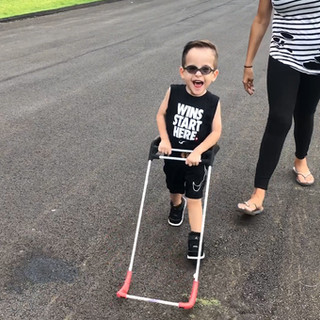
Updated: Sep 16
There really is only one question needed.
Offering an easier framework for determining if a visually impaired child needs a mobility device.
Early Focus (2026), 3rd edition textbook offers four questions to use when considering whether a child needs an adaptive mobility device:
Does the device motivate the child to move?
Does the child have a significant physical or cognitive disability that interferes with the child's ability to protect themselves with a long cane?
Does the child need to increase proprioceptive and kinesthetic awareness to interpret feedback and protect themselves with a cane?
Is the device socially appropriate for the child's age and environment?
At first glance, these questions may appear comprehensive. But for a child with a mobility visual impairment or blindness (MVI/B) these questions overcomplicate and often serve to delay their access to life-saving mobility tools. The purpose of this article is to explain why these questions just over-complicate the decision to provide a VI child a necessary device.
There really is only one question we need to ask when determining whether a VI child needs a mobility tool - can the child rely upon impaired vision for path preview, or not?
There is only one question to ask to determine if a child needs a mobility tool:
Is the child blind or mobility visually impaired?
Like the blind child, a child with an MVI has a vision impairment that makes moving about dangerous (e.g., an overall blur, lower field impairment, or a cerebral visual impairment). We can see the impact on their motor skills, slow pace, seeking handheld assistance, spinning. A child with an MVI/B needs adults to immediately recommend a mobility tool. For most children, that will be either a Belt Cane or an Adaptive Mobility Device (AMD). As MVI/B children struggle to employ long cane skills most of the day.
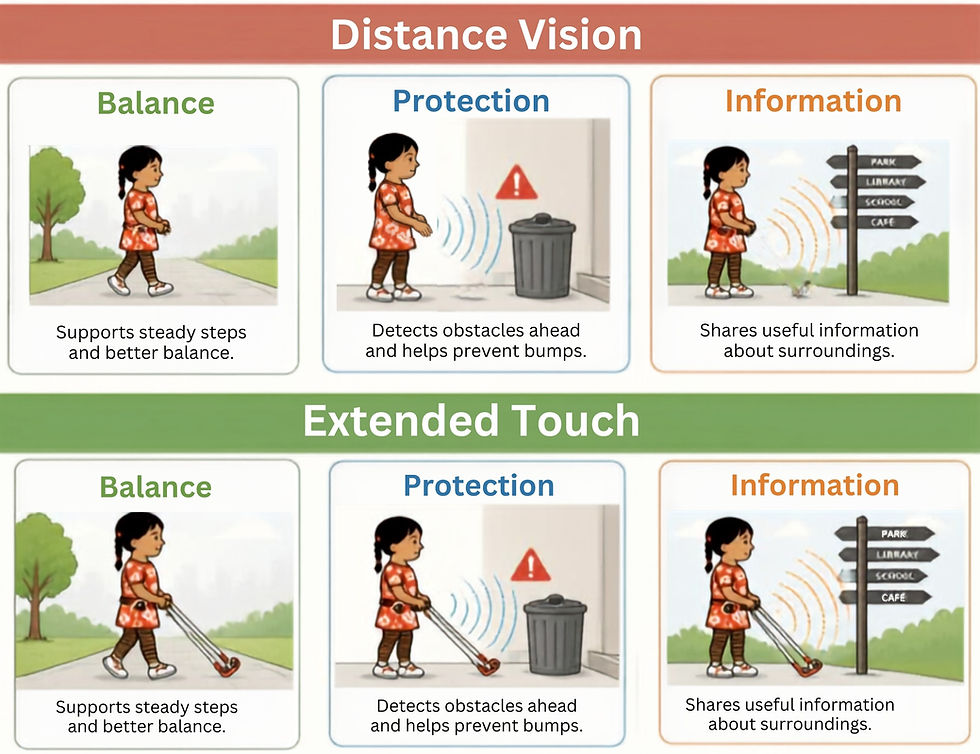
Blind or Mobility Visually Impaired means the child's vision impairment makes them unable use vision for balance and path preview.
The degree of vision impairment is the fundamental issue. When the answer is yes my child has an MVI/B, then the discussion should quickly move to the next question: What mobility tool is developmentally appropriate for my child?
An MVI/B Child Should Not Have to “Fail” at the Long Cane First
The Early Focus (2026) textbook have two criterion that ask families of young children to first evaluate the child's long cane use. And only when they are proven unable to use the long cane correctly, then provide an alternative device.
Recommending that the child fail with the hardest device, first runs counter to most forms of instruction. Instead in any new activity, especially with toddlers and preschoolers, most people would logically begin with the easiest device and only increase difficulty level when that matches the ability and experience of the child.
A mobility tool is part of the MVI/B child's developmental pathway toward greater body awareness, environmental understanding, and independent movement. There should be no pre-requisite failure needed before getting an easy-to-use mobility tool.
Early Focus (2026) fourth criterion asks whether a mobility device is socially appropriate for the child's age and environment.
“Socially Appropriate” Should Not Determine Whether a Blind Child Gets an Easier Mobility Device
This is perhaps the most concerning criterion. Why? Because social appropriateness is subjective.
What one adult considers socially appropriate, another may consider unnecessary, unattractive, unusual, or stigmatizing. But mobility devices exist to serve a functional purpose. The important question is not:
Does this device look a certain way.
It is:
Does this device provide the child with the protection they need?
A device must functional in the environments in which it will be used. Physical abilities and developmental abilities matter. But those are different from asking whether the device is socially acceptable to the adult. A child's access to independent movement should not be limited by what it looks like to others.
Function comes before appearance.
How to Determine the Appropriate Mobility Device?
Use a two-step framework.
STEP 1: Determine whether the child is mobility visually impaired or blind.
If you are uncertain if your child has an MVI, you can use the walking assessment shown in the first video to determine what impact the child's vision impairment has already had on their walking ability. A mobility improves gait, pace, posture and amount of physical activity in learners with an MVI/B.
STEP 2: Choose the mobility tool that will immediately help the MVI/B child.
Which of the three devices can the child physically and cognitively understand and use immediately? There are only three choices:
1) The Belt Cane is worn about the waist, making it the easiest device on the market today.
2) An AMD is usually handmade by someone in their garage. The child has to hold on and steer it with two hands making it moderately difficulty.
3) The long cane was developed for WWII veterans who were blinded by war but otherwise able to return to the workforce. The small cane tip must be swung back and forth with each step making this device difficult to use correctly. Research shows that poor long cane technique is unsafe.
Three Choices: Belt Cane (easy), an AMD (moderate), or a long cane (hard).
Mobility Device Selection
There is an important principle here that applies beyond any single mobility device: The purpose of a mobility tool is to give the child with an MVI/B access to information and protection that their vision cannot provide. The choice should be based on filling an immediate need.
And as children mature, they should increasingly participate in decisions about the tools they use. That is what independence ultimately means.
The Questions We Ask Matter
If your child's professionals ask you to wait until your child fails to use a long cane or suggests other devices are not socially appropriate they are over-complicating the issue and ultimately delaying access to safe mobility.
Instead ask them to begin with:
Does my child have a mobility visual impairment or blindness?
Then they can ask:
What mobility tool will immediately help my MVI/B child?
That is a much clearer clinical and educational pathway.
Blind Children Should Not Have to Wait to Feel Protected While Moving
For practical tools for evaluating early mobility and planning mobility goals, visit the Safe Toddles Documents Center.
For professionals and families who want to explore early mobility development in greater depth, Safe Toddles offers the Blind Baby Safe Mobility Curriculum, including assessment, mobility development, Belt Cane implementation, and strategies for children with additional disabilities.
The curriculum page confirms those components and includes practical demonstrations and continuing education information.
Chong, P., Brown, A. D., Enzenauer, R. W., & Ambrose-Zaken, G. (2026). The Role of a Pediatric Belt Cane in Children with Cerebral Visual Impairment. Clinical Ophthalmology, 20, 572112.


Comments