


Examining the Lesson: Mobility Tools and Route Learning
Updated: May 9
A new video is now live on YouTube
We’ve just released a new 3 minute 38 second video that takes a close look at how mobility instruction impacts real independence for blind and visually impaired children—and it raises an important question:
Are we teaching children to move… or to understand where they’re going?

The Lesson We’re Examining
In this video, a 5-year-old student with optic nerve hypoplasia (ONH) is learning a simple but essential route: from the playground door back to her classroom.
Without a mobility tool, the instructional strategy relies on following a constant playing nursery song. The prompt is: “find the ducks.”
And to be fair—this approach does produce movement. She walks. She progresses forward.
But when you look closely, the limitations become clear.
Her gait is slow and wide-based
She stops frequently
The destination is unclear and abstract
There are no actual ducks—so what signals “arrival”?
She is participating in the lesson, but she is not being given the information she needs to truly orient herself in space.
What’s Missing without a Mobility Tool
Without a tool, she lacks touch preview—the ability to detect what’s ahead before encountering it.
That means:
Surface changes come as surprises
Obstacles are reactive, not anticipated
The route cannot be broken into meaningful, repeatable segments
The strategy works in the narrow sense: she moves toward a sound.
But it does not build a reliable, independent understanding of the route.
What Changes with the Belt Cane
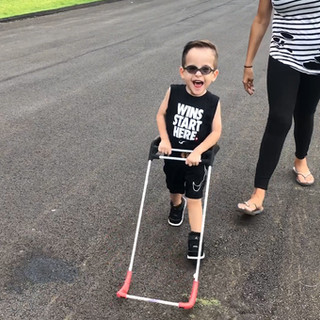
When the Belt Cane is introduced, the lesson transforms.
Now, instead of following an artificial cue, she begins to gather real environmental information through extended touch.
She starts to:
Detect transitions in ground surfaces
Identify obstacles before reaching them
Recognize tactile landmarks along the way
Build the route in segments—from one known point to the next
This is route learning in a meaningful sense.
Each segment connects to the next, forming a clear path from a known starting point (the playground door) to a known destination (her classroom).
A Moment That Says Everything
Near the end of the route, something important happens.
She notices the classroom door and reaches out to confirm it with her hand.
No prompt. No “ducks.” No guesswork.
She knows where she is.
Even more telling—she’s drawn toward the natural sound of her classmates inside. The environment itself becomes motivating and meaningful, replacing artificial cues with real-world context.
Why This Matters
This isn’t just about one route.
It’s about how we define success in mobility instruction.
If a child can follow a sound, we might say the lesson worked. But if the child cannot identify where they are, where they’re going, or when they’ve arrived—then independence is still out of reach.
Mobility tools like the Belt Cane don’t just help children walk. They help children understand space, build routes, and move with purpose.
Watch the Full Video
We invite you to watch the full lesson and see the difference for yourself.
👉 Examining the Lesson: Mobility Tools and Route Learning is now available on YouTube.

After you watch, consider this:
What are we asking children to rely on—temporary prompts, or information they can use again and again?
For more about our work and the Belt Cane, visit:safetoddles.org
To learn more about integrating the Belt Cane into an MVI/B child's daily physical activities and obtain ACVREP CEUs go to our curriculum and courses: https://safetoddles.podia.com/
The Blind Baby Safe Mobility curriculum was funded by generous donations Nicholas B. Ottaway Foundation, the Delta Gamma Foundation, and people like you.


Comments