


Walking Has a Purpose: From First Steps to Meaningful Movement
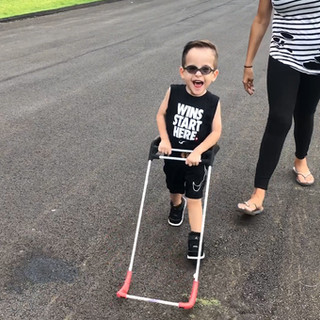
Walking starts as a goal—then becomes a gateway.
At 10 months, a child isn’t trying to “get somewhere.” They’re discovering movement itself. Standing up, dropping down, rocking on hands and knees—this is exploration for its own sake. By 12 months, something shifts. They reach for your hands, take a few steps, and begin to understand that movement can connect them to people and places.
They pull up on the couch. They cruise along furniture. Some take those first independent steps into the middle of the room—unsteady but determined.
By 15 months, most children have let go. They walk with a wide-based gait, slower than adults but remarkably capable—navigating around obstacles, choosing where to go. Running shows up too, though not yet controlled. It’s enthusiastic, not efficient.

After 18 months, walking and running become skilled. And by age 2, something important happens: Walking is no longer the focus. It becomes the tool.
Now movement serves a purpose.
“I want to play chase, so I run away from you.”
“I want that toy, so I walk across the room.”
What once felt like a distant milestone becomes routine—and that’s exactly the point. Because once a child walks well, the world opens.
Now we teach:
What things are called
What they’re for
How to use them
What’s safe to touch—and what isn’t
When to stay close and when to explore freely
How to move through a playground, not just arrive at it
Walking becomes the foundation for learning, socializing, and independence.
When Walking Doesn’t Become Purposeful
If a child with a mobility visual impairment or blindness (MVI/B) is still struggling to walk—or seems to be walking less over time—that’s not something to gloss over.
Pay attention to the pattern:
They hesitate to move across open spaces
They need a hand to walk to the door, the car, or the toy shelf
They avoid movement unless guided
That’s not a lack of ability. It’s a lack of access.

And here’s the hard truth: You cannot expect purposeful walking without the right sensory input. Sighted children use vision to guide every step—providing distance, safety, balance, and awareness. Children with an MVI/B rely on touch as their dominant sense. But touch, without extension, only gives information about what’s already too close.
So, when we ask a child to walk independently for hours each day without giving them extended touch feedback, we are asking them to move without the very input that makes movement safe and meaningful.
That’s not just ineffective—it can delay progress and reduce confidence.
The Role of Extended Touch
A mobility tool like the Belt Cane changes the equation.
It provides:
Extended touch feedback to detect obstacles before contact
A protective buffer between the child and their environment
Balance support through consistent tactile input
Spatial awareness, replacing what vision would typically provide
This is not an “extra.” It is essential.
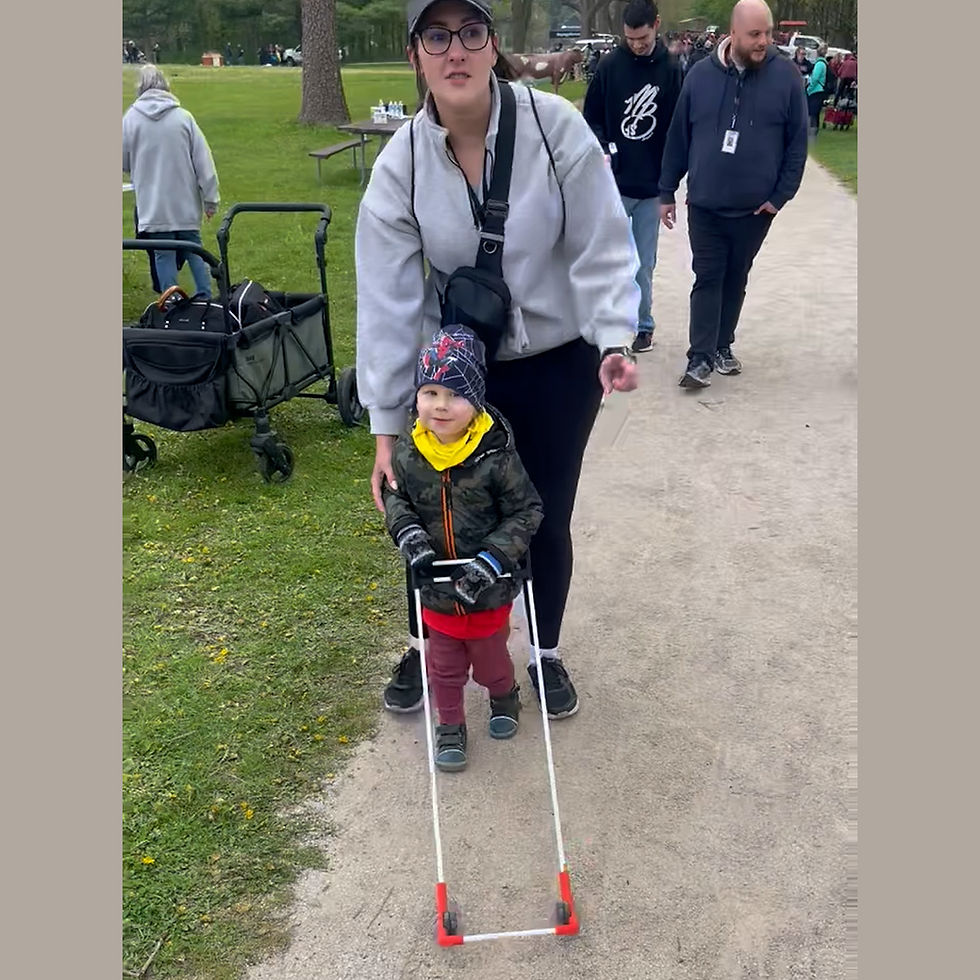
And just as importantly, it must be used consistently—not for an hour here or there, but throughout the child’s daily activities. Expecting a child to build skill without consistent access to their primary feedback system is like expecting a sighted child to learn to walk in the dark.
Walking With Purpose—Through Touch
A child with an MVI/B can absolutely reach the same outcome as their peers: walking and running as a natural, effortless means to an end.
But they don’t get there by doing less. They get there by being given the right input.
Touch is their pathway.
With the Belt Cane, walking becomes:
Safer
More confident
More frequent
More purposeful
And once walking becomes routine, everything else follows—learning, play, independence, and connection to the world around them.
They don’t need to wait to “be ready.”
They need the right tool to get there.
To learn more about how to fit a child with their first Belt Cane and integrate it into your early intervention programs go to Blind Baby Safe Mobility (Earn ACVREP CEs): https://safetoddles.podia.com/


Comments