


Understanding Mobility for Blind Children: The Importance of Active Exploration
Updated: Sep 14
If your child with a mobility visual impairment or blindness (MVI/B) can physically walk, but instead spends most unoccupied time sitting, it is time to examine their access to self-reliant mobility. Self-reliant mobility is having the mobility tool necessary to confidently pick their own path.
Sitting is expected during some activities—art projects, puzzles, snacks, books, and quiet floor play often happen seated. But if sitting has become the default during the child's day, that is something to be concerned about.

The concern is not sitting itself.
The concern is whether sitting or spinning has replaced active, self-reliant, and outwardly engaged interactions that are recognized as part of childhood. Once sighted children can walk, they change their location fairly frequently seven plus hours a day.
A child's vision impairment robs them of the visual ability to keep themselves safe. MVI/B children's impairment is such that they need the protection of a mobility tool, so they can profit from unexpected collisions. Without a tool, they learn instead that it is safer to sit and wait for a helping hand, than risk moving solo.
Parents of children with an MVI/B are often told not to worry because..:
Their child began walking early and can walk.
The child seems content playing "in their own way" and "in her own world."
The Love for Movement
Blind children love to move. Yet, without a mobility tool you might never believe it, instead a child with an MVI/B may be said to be "choosing to" sit, scoot, cruise, roll, or stand only to turn in circles. Adults may cherish how these children always seem to choose to stay closer to them compared to their (sighted) brother or sister.
But look closer, they are choosing to wait for a helping hand To them, the best option is staying put or walking with a handheld are the safest choices.
What seemed "baked in" as a natural part of blindness, no longer needs to be.

We all know what walking looks like, yet parents of children with an MVI/B have been told those "walking norms" don't apply to their blind child. They are convinced that any amount of walking is a triumph. And, their poor skills are attributed to a lack visual motivation.
Consider Phoebe. At age 7, unable to take 3 solo steps at home in her living room. And days later, wearing her Belt Cane she is self-reliantly walking through her school.

The narrative that blind children are lacking sensory information needed to entice them to walk is true. But it isn't just their vision... they don't know that lack of sight is what's tripping them up, touch is. They can't see anything, but they feel everything.
Blind toddlers know and love touch feedback
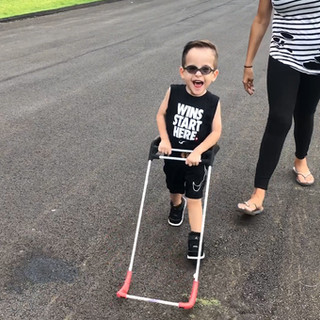
Toddlers with an MVI/B know and love touch feedback, and the cane frame allows them to claim the space ahead of themselves and use tactile signals from the cane frame to move with self-reliance.
The Role of Mobility Tools
For the child unable to detect obstacles visually, a mobility tool's touch feedback enriches their feeling of space as they move. The stops, bumps, and scrapes felt through the came frame fills their brains with exciting information about what is ahead. The more they feel, the more moving solo becomes easy, predictable, and safe.
The developmental gap is easy to see. When the motor skill of walking is present in a visually impaired child but is used less and less for their independent exploration, the older the child becomes. That's the time to worry and act quickly, not make excuses.
The time to act is now.
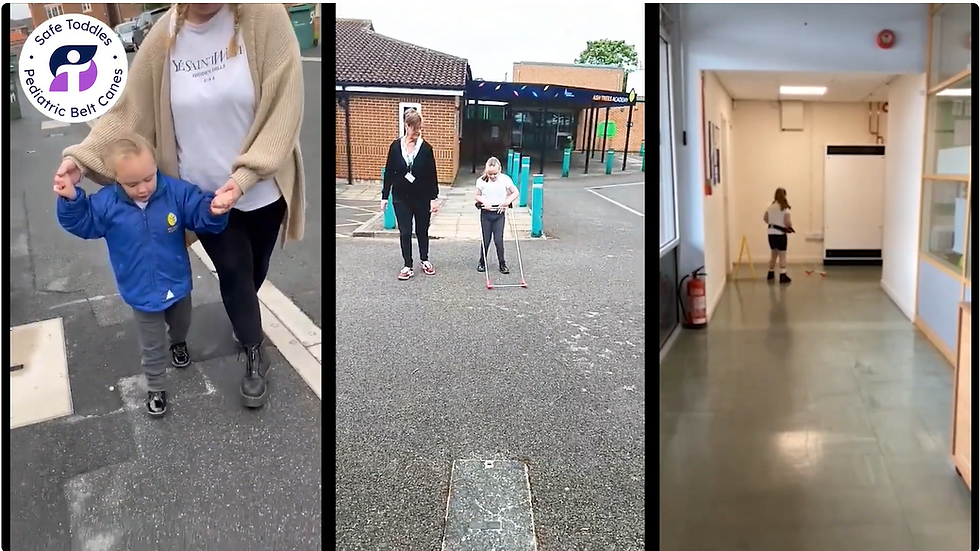
Independent walking feels safe and attainable with the right tool. A child with an MVI/B able to move needs a mobility tool so they can extend their touch to preview the path ahead. Without any way to extend their touch, sitting becomes the safest option—the child without a reliable way to explore independently is left with no choice, but sit.
In conclusion, we are advocating for children with an MVI/B to have the opportunity to explore their environment actively. The right mobility tool empowers them to move confidently and independently. By recognizing the importance of active exploration, we can help children with an MVI/B thrive in their journey of discovery.
Let’s ensure that blind children are actively engaging with the world around them. After all, movement is a vital part of childhood.


Comments