


When Blindness Is Mistaken for “Behavior”: Why Blind Children With Intellectual Disabilities Need More Touch Feedback, Not Less
Updated: Aug 11

Parents of blind children are too often told a damaging story:
“Your child is on the spectrum.” “That’s why he doesn’t use the long cane correctly.” “He’s not ready for independent mobility.”
But then what happens next?

Your blind child is still expected to hold a long cane part of the time.
Other times, there is no expectation to use the cane at all.
Meanwhile, the blind child spends hours spinning, sitting, or staying close to adults instead of confidently moving through the world.
That is not a credible blindness solution.
And it is not what childhood is supposed to look like.
A 2-year-old boy does not naturally want to sit all day.
A 3-year-old does not naturally choose passivity over exploration.
Children are designed to move.
When blind children stop exploring, we should ask an important question:
Is the child refusing movement — or missing the tactile information needed to move safely?
Blind Children Learn Through Touch

Sighted children constantly receive environmental feedback through vision:
Where the doorway is
Where the curb begins
How far away the wall is
Which direction the hallway continues
Whether the path ahead is open
Blind children need this information through touch.
Without consistent tactile feedback, movement becomes uncertain, stressful, and exhausting.
Many blind children who are also intellectually disabled or nonverbal need even more environmental feedback — not less.
Yet traditional mobility approaches often remove touch information instead of increasing it.
The result?
The cane is put down during play
The child walks unprotected
Adults guide constantly
Exploration decreases
Repetitive behaviors increase
Independence shrinks
Spinning Is Not the Same as Exploring
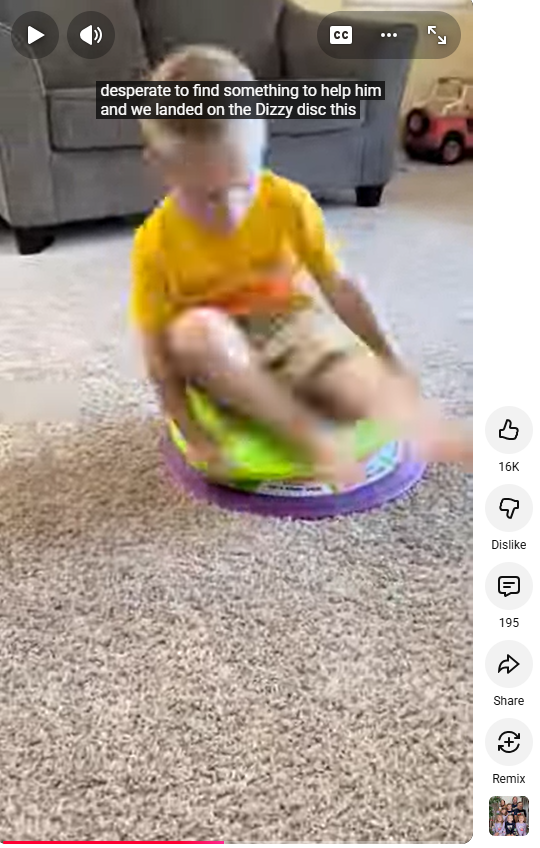
Spinning can be joyful.
Rocking can be regulating.
Movement differences are real.
But spinning is confined independent exploration.
A child who cannot safely preview the space ahead may retreat into repetitive movement because the environment feels unpredictable.
That does not mean the child with a mobility visual impairment or blindness (MVI/B) lacks the desire to move.
Without a mobility tool, the MVI/B child lacks continuous tactile access to the world around them.
The Belt Cane increases the amount of information an MVI/B Child Receives
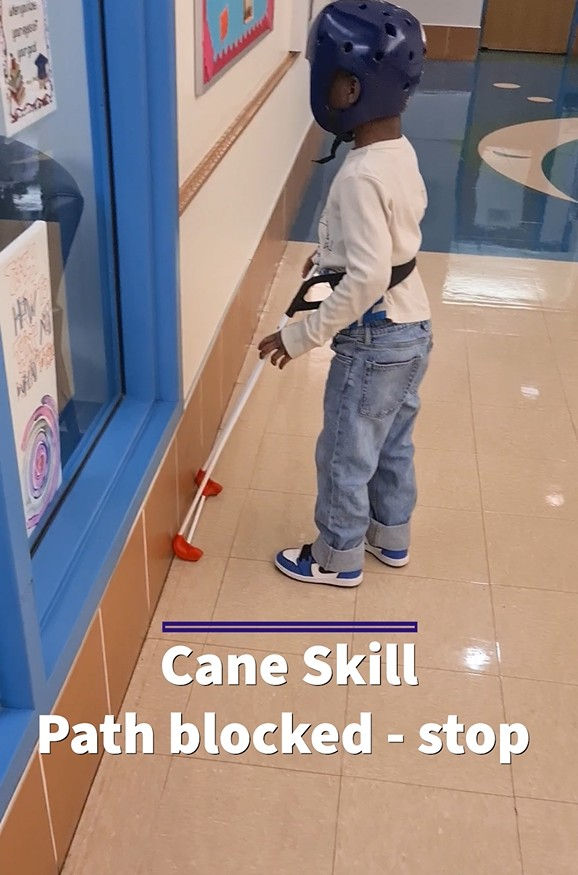
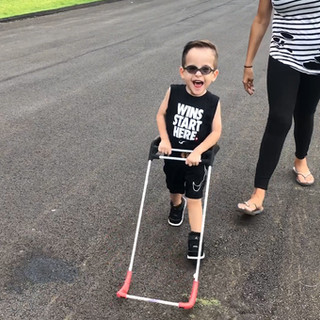
The Pediatric Belt Cane was developed to provide blind children with:
Extended touch feedback
Continuous environmental preview
Full arc lower-body protection
Hands-free movement
Constant tactile learning during real-life activities
Instead of asking a young child with an MVI/B to remember to hold and correctly position a long cane, the Belt Cane allows tactile feedback to remain connected to the MVI/B child’s body during movement.
This matters enormously for MVI/B children with developmental delays, intellectual disabilities, motor planning challenges, or nonverbal communication.
Because tactile repetition builds understanding.
And understanding builds confidence.
We Have Seen What Happens When Blind Children Receive Continuous Tactile Feedback

Our videos show intellectually disabled blind boys who began using Belt Canes at ages 2 and 3 and later:
Walk independently
Learn school routes
Travel through hallways confidently
Get on and off the school bus independently
Move with purpose instead of hesitation
These are not blind children who were “incapable” of moving independently. These are children with an MVI/B who finally received enough tactile information to understand to move confidently through their environment.
Intellectual Disability Is Not a Reason to Reduce Mobility Access
In many cases, it is the opposite.

An MVI/B child who cannot see the path ahead and who also struggles with language, motor planning, or cognitive processing needs more tactile structure and environmental consistency, not less.
Adults must stop assuming that lack of traditional long cane success means a child with complex disabilities does not benefit from the extended touch provided by mobility tools.
The question should not be:
“Can this child use a long cane correctly?”
The question should be:
“How can we provide this child with enough meaningful touch feedback to move independently and safely?”
Blind Children Deserve to Explore

We are the grown-ups.
It is our responsibility to understand that touch is not secondary for children with an MVI/B. It is foundational.
Blind toddlers and preschoolers deserve to:
Move
Explore
Take risks safely
Learn routes
Build body awareness
Develop confidence
Experience independence early
Especially those who are also intellectually disabled.
Because every child deserves the opportunity to understand the world through movement.
Watch Real Children Using the Belt Cane
Vinny: Blind at 1 Year Old — Not Missing Milestones
A powerful example of early tactile mobility support and active development.
Maddox: Began Using His Belt Cane at Age 2 — Still Using It Independently at Age 8
Watch how consistent tactile feedback supported long-term independent mobility.
Jorge: Began Using His Belt Cane at Age 3 — Walking Independently at Age 6
See independent travel, route learning, and confident movement in action.
To learn more about Belt Cane integration into a child's daily physical activity and earn ACVREP CEUs go to our curriculum:


Comments