


Why Walking Success in Blind Children Should Be Boring
Updated: Aug 11
The Walking Milestone We Celebrate—and Then Forget
Few developmental milestones are anticipated as eagerly as a child's first steps.
Parents count the days. Family members cheer. Videos are shared. Baby books are updated. Entire industries exist to help infants reach this milestone.
Then something remarkable happens.
Once walking becomes easy, we stop thinking about it.
Walking includes the ability to stand up and interpret visual information to easily move across a room, visually explore a playground from a far and walk towards a friend or favorite toy. Walking, this complex sensorimotor skill that once seemed inconceivable when viewing the newborn infant, typically becomes so effortless that it disappears into the background of daily life. Sight-guided movement becomes ordinary, almost invisible.
And that is exactly how it should be. And, with the right mobility tool, that is how it can be for blind infants, too.

Walking Changes Everything
The ability to confidently select a clear path through one's living room and navigate daily routes with speed and efficiency offers profound possibilities. Walking relies on sensory information and both distance vision and extended touch feedback are equal to this task.
At the same time sighted children refine their skills in visual navigation, with the Belt Cane, children with a mobility visual impairment or blindness (MVI/B) can refine their skills in tactile navigation. Sensory-led movement expands exploration, learning, social interaction, confidence, and access to everyday experiences.
With the right mobility tool, extended touch can become the dominant sense for walking.
With the right mobility tool, blind children use extended touch to enhance their sense of touch harnessing that super power to gather vital information for navigating the world around them.
Before the Belt cane, blindness itself has often been cited as the explanation for delayed walking.
Parents of children with an MVI/B have been told to expect later walking.
Professionals have documented delayed mobility.
Researchers have described the developmental challenges associated with moving through space without vision.
In a study of 50 children with the mean age of 29 months (well over 2 years old); the physical activities were compared in the same child before and after wearing Belt Canes for 12 weeks. These children with an MVI/B were raised with access to handheld mobility tools, but did not use them all the time. The blue lines show that their activities were to sit down, stand holding on to an object, walking holding on to a person. The amount of sitting and solo walking was significantly different in these two conditions.
Before Belt Cane: These children sat down.
With Belt Cane: These same children walked and ran around.
That is why an important distinction deserves attention:
As the above graph demonstrates, walking delays associated with blindness occur in children with an MVI/B of all ages who grow up unprotected by a mobility tool, after 12 weeks of daily use, these same MVI/B children significantly increased their amount of solo walking, when wearing a Belt Cane.
The Missing Ingredient has always been Sensory: Extended Touch Feedback
Sighted toddlers develop walking ability by improving their ability interpret visual information about their environment. Sight-dominant walking is also taken for granted.
Sighted people find it easy to avoid obstacles, identify destinations, estimate distances, and anticipate changes in terrain.
Blind toddlers do not have access to this visual preview. However, humans possess another remarkable system for gathering information: touch.
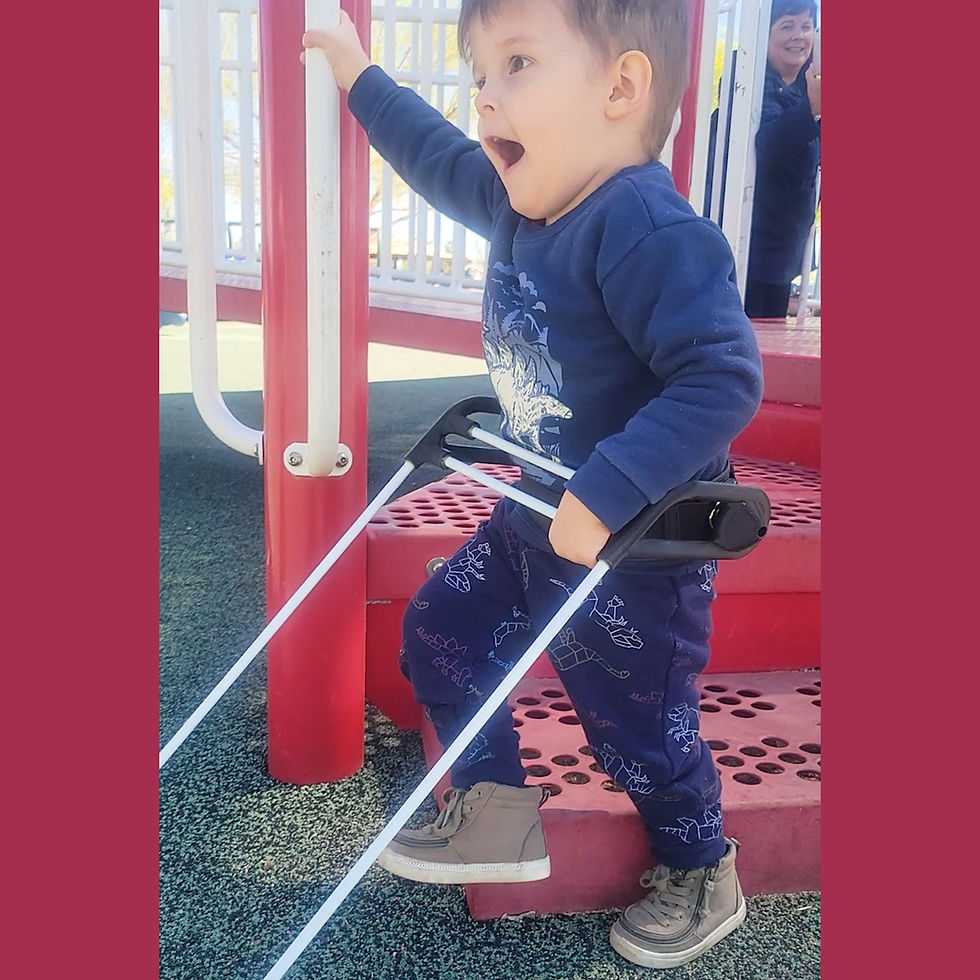
When touch is extended to the floor 2 steps ahead of the body through a mobility tool, MVI/B children can begin receiving information about the environment before their hands, knees, or face encounter it.
This concept, known as extended touch feedback, is the reason we teach long cane use. The question has never been whether extended touch works.
The question we answered in this Final Report to the Lavelle Fund for the Blind was that young MVI/B children can walk more effortlessly when they wear a Pediatric Belt Cane.
Why Belt Cane Walking Success Is Almost Boring
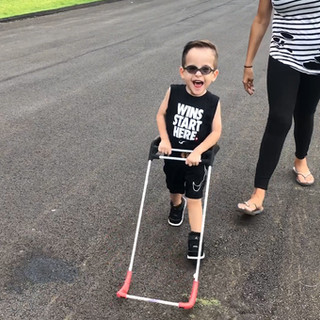
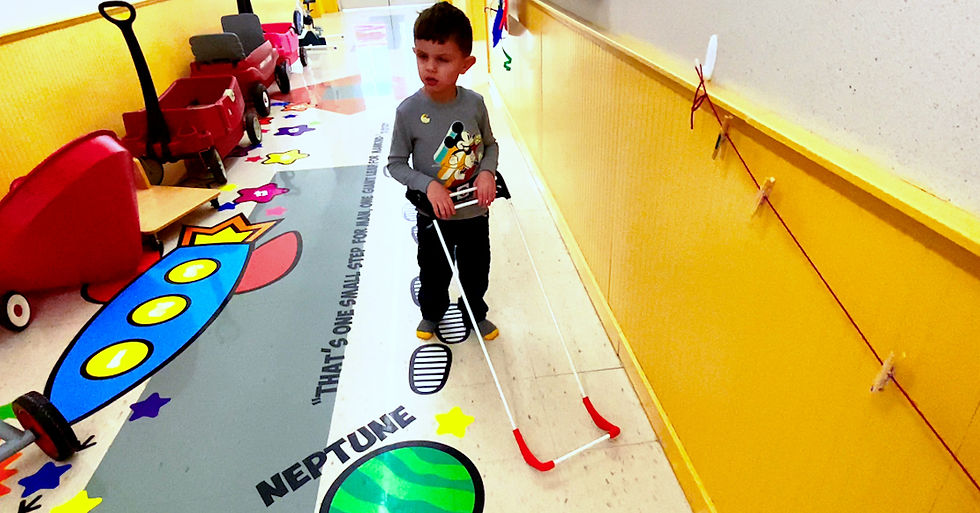
One of the most striking observations reported by families using the Pediatric Belt Cane is how ordinary walking begins to look.
MVI/B Children stand, take steps.
MVI/B Children navigate around obstacles as they move from place to place.
MVI/B Children become busy being toddlers, under foot, a danger to themselves.
There is often no dramatic moment, walking becomes the catalyst for which it was intended.
The discovery of a new route, new problem to solve, and new words takes over.
No extraordinary adaptation visible to the casual observer. Instead, walking simply starts becoming part of daily life.
In many ways, that outcome is almost boring. And that may be the strongest evidence that something important is happening.
The goal of mobility intervention is not to create impressive demonstrations. The goal is to provide children with the sensory information they need so movement can become natural, efficient, and automatic.
When walking becomes unremarkable, exploration can take center stage.
The video of Marlowe, age 3 and blind, compares her walking (before) with a sighted guide as her only mobility tool and her solo walking (with) when wearing a Belt Cane and O&M skills she began learning, as an independent walker.
We Forget How Important Walking Really Is
Most adults cannot remember learning to walk. We do not consciously think about every step we take. Walking is so integrated into human experience that we rarely notice its value until it is limited.
Yet solo walking represents freedom.
Solo walking allows children to choose.
Solo walking creates opportunities for learning, social engagement, and confidence. When a child can move independently, the entire world becomes more accessible.
The Cost of Waiting
Historically, MVI/B children spend their earliest years relying on hands-on guidance, physical support, waiting until their long cane mobility technique improves to the point where each step has been checked first by the touch of the cane tip.
As well-intentioned as this long-term approach is, it is wrong because it takes too long. Every month of reduced independent exploration represents missed opportunities to practice balance, spatial awareness, problem-solving, route learning, confidence building, and self-directed discovery.
The developing brain learns through action.
Children learn by moving. The risk to the MVI/B child is the might never learn to use the long cane technique correctly. Like this little 9-year-old girl living in Uganda. She was still relying completely on sighted guide, until her teachers got her a Belt Cane.
Giving Blind Children Access to Information
The conversation should not center on whether physically able blind children can walk.
Of course they can. They can they let go of the helping hand, how long after letting go of the helping hand do they continue to walk solo? What about the obvious the risk to them when they walking with no protective mobility tool?
The more important question is whether they have access to extended touch feedback to gain environmental information needed to support confident, independent movement during the earliest stages of development.
Extended touch feedback provides information.
Information supports movement.
Movement supports exploration.
Exploration supports development.
The chain is remarkably simple.

The Future of Early Mobility
Perhaps the greatest compliment that can be given to an early mobility tool is that its success becomes invisible. Like Phoebe, age seven and before getting a Belt Cane her mom was amazed when she took 3 solo steps.
No one celebrates every step taken by a typical seven-year-old.
No one applauds a teenager for walking across a room.
No one marvels when an adult navigates a grocery store.
Walking is expected because it has become effortless.
Blind children like Phoebe deserve the same expectation when provided with the right mobility tool.
They deserve access to tools and strategies that provide meaningful environmental feedback. They deserve opportunities to experience movement as something natural rather than something delayed.
And they deserve the chance to achieve what every parent ultimately hopes for:
Not extraordinary walking.
Just ordinary, effortless, wonderfully boring walking.

Comments