


12 New York Children Can Receive a Pediatric Belt Cane and Training
A $15,000 grant from The Joseph Leroy and Ann C. Warner Fund of New York City will help Safe Toddles provide Pediatric Belt Canes and training to 12 New Yorkers.

Safe Toddles is deeply grateful to The Joseph Leroy and Ann C. Warner Fund of New York City for a $15,000 grant supporting Pediatric Belt Canes and training for 12 children with blindness or a mobility visual impairment.
This grant creates an important opportunity for New York families.
If you are the parent or caregiver of a child 10 months or older who is blind or has a mobility visual impairment, we want you to know about it.
Your child may be eligible to receive a Pediatric Belt Cane and individualized training at no cost through this grant.
You do not have to know whether your child is "ready" for a cane. You do not have to be an O&M expert. Start by contacting Safe Toddles.
safetoddles.org/contact-us or Email info@safetoddles.org to learn more.
A grant designed to put innovation into the hands of children
The Joseph Leroy and Ann C. Warner Fund supports innovative organizations that provide meaningful services to children with disabilities and children in foster care.
The Warner Fund recognizes that important needs can go unfulfilled when existing systems do not provide the right solutions. Its grantmaking seeks organizations with creative approaches that go beyond simply accepting the status quo and instead ask what else might be possible?
That vision is closely aligned with the work of Safe Toddles.
For young children with blindness or a mobility visual impairment (MVI/B), mobility has traditionally been approached with tools developed for newly blind adults.
Safe Toddles asked a different question:
What would happen if we designed a mobility tool specifically for an MVI/B child who is just learning to walk?
The Pediatric Belt Cane was developed from that question.
Could your child benefit from a Belt Cane?
A blind baby or toddler does not stop wanting to move simply because they cannot see obstacles.
They still want to crawl across the room to a toy.
They still want to walk toward a parent.
They still want to explore a playground, enter a new room, walk down a sidewalk, and move toward the things that interest them.
But many young children with blindness or low vision struggle with independent movement because the mobility tools traditionally available to them may not match their developmental stage.
You may want to contact Safe Toddles if:
Your child with an MVI/B is walking but frequently bumps into things.
Your child with an MVI/B waits for an adult to guide them rather than walking toward a destination independently.
Your child with an MVI/B walks confidently only in familiar spaces.
Your child with an MVI/B becomes hesitant or stops when the environment changes.
Your child with an MVI/B does not consistently use a handheld cane while walking.
Your child with an MVI/B has been given a push toy or other mobility device but rarely uses it.
You have been told that your child's mobility is simply "normal for a blind child," but your gut tells you your child could be doing more.
You want to introduce independent mobility earlier but don't know what tool or approach is appropriate.
You don't need to check every box.
If you are wondering whether a Belt Cane might help your child, contact us.
What is a Pediatric Belt Cane?
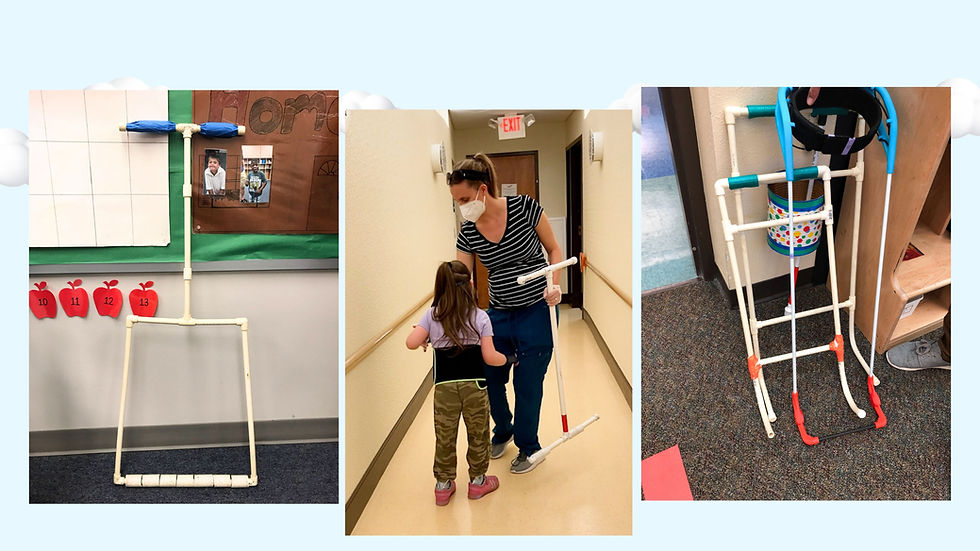
The Pediatric Belt Cane is a mobility tool designed specifically for young children with blindness or a mobility visual impairment.
Unlike a traditional handheld cane, the Belt Cane is worn at the child's body.
Its design allows a young child to receive information about obstacles and the space around them while keeping their hands available for balance, play, and exploration.
The Belt Cane is not simply a smaller version of an adult long cane.
It was developed for MVI/B children who are still developing balance, coordination, walking skills, and an understanding of how to move through space.

The grant provides more than a mobility device
The Warner Fund's support will allow Safe Toddles to provide 12 New York children with both a Pediatric Belt Cane and the training needed to begin using it.
Pediatric Belt Cane
Each participating child will receive a Belt Cane appropriate to their needs and stage of development.
Fitting and training
Families will receive guidance on fitting the Belt Cane and introducing it into everyday movement and exploration.
Implementation support
Safe Toddles will help families understand how to incorporate the Belt Cane into daily routines and different environments.
The goal is not simply to put a device in a family's hands.
The goal is to help the child actually use it.
Why the training matters
A mobility device is only useful if a child can successfully incorporate it into everyday life.
Families may wonder:
How do I introduce it?
How long should my child wear it?
What should I expect at first?
How do I encourage my child to move with it?
What should I do when my child encounters an obstacle?
How can we use it at home, at school, on the playground, or outside?
Safe Toddles provides individualized support to help families answer these questions.
The grant will also support training using the Blind Baby Safe Mobility Curriculum, developed by Dr. Grace Ambrose-Zaken.
This means the Warner Fund is helping provide not only access to the equipment, but also access to the knowledge and support needed to make that equipment part of a child's daily mobility.

This work began in New York
New York has a special place in the history of the Pediatric Belt Cane. Invented by two City University of New York professors, Helen Keller Children's learning center students were the first to trial the Belt Cane in 2017. With a grant from the Department of Education they helped us test our unique mobility tool.
Two-year-old Charna became the first New Yorker to wear a Belt Cane most of the day, her videos are on our YouTube channel. Before the Belt Cane, she wasn't allowed in the toy room because the floor was a mess. When wearing her Belt Cane, she walked self-reliantly every where inside and out.
That early experience helped demonstrate what Safe Toddles had hoped might be possible: a young blind child could use a wearable mobility tool to move more freely and confidently through her environment.
Since then, Safe Toddles has continued developing, researching, and providing Pediatric Belt Canes to children throughout the United States and around the world.
The organization has now provided thousands of Belt Canes to children in the United States and internationally.
The Warner Fund grant brings that innovation back to the New York community where the work began.
Why early mobility matters
Movement is how children begin to learn about their world.
A child moves toward a sound.
Reaches for a toy.
Follows a caregiver.
Walks across a room.
Explores a new space.
Each movement provides information and builds experience.
For children with a mobility visual impairment or blindness (MVI/B), early mobility may require additional tools and support.
The goal is not simply to prevent bumps.
The goal is to give MVI/B children more opportunities to move toward what interests them.
That might mean exploring a hallway, walking into a playground, moving through an apartment building, entering a classroom, or navigating a sidewalk with greater awareness.
Early opportunities to move and explore can become building blocks for later independence.
A meaningful investment from the Warner Fund
Safe Toddles is especially grateful to The Joseph Leroy and Ann C. Warner Fund for recognizing the importance of investing in innovative solutions for children with disabilities.
The Warner Fund's support makes it possible to take an innovation that has already reached children around the world and make it available to 12 additional New York children and their families.
And importantly, the grant supports the complete process:
the child gets the tool, the family gets training, and Safe Toddles provides ongoing support.
That is what makes this grant so meaningful.
It turns funding into something a child can experience every day:
the opportunity to move.
Is your child one of the 12?
If you live in New York and have a child 10 months or older who is blind or has a mobility visual impairment, we encourage you to contact Safe Toddles.
You don't need to wait until your child is older.
You don't need to wait until your child has mastered a long cane.
And you don't need to decide on your own whether a Belt Cane is appropriate.
Tell us about your child. We'll help you understand whether this opportunity may be a good fit.
Contact Safe Toddles
Go to safetoddles.org/contact-us or email info@safetoddles.org
Please include your child's age, location in New York, and a brief description of their current mobility.
There are 12 opportunities available through this grant.
If your child needs one of them, we want you to know that this opportunity exists.
Thank you, Warner Fund
Safe Toddles extends its sincere gratitude to The Joseph Leroy and Ann C. Warner Fund of New York City for this generous investment in New York children with disabilities.
Your support allows us to do something very concrete:
put an innovative mobility tool into the hands—or around the body—of a child who needs it, and help that child learn to use it.
For one child, it may begin with a few steps across the living room.
For another, it may mean walking down a hallway independently.
For another, it may mean exploring a playground instead of waiting to be guided.
Those opportunities matter.
Thank you to the Warner Fund for helping make them possible for 12 New York children.

Comments