


Greater Expectations: When a Blind Toddler’s Walking Delay Is Easy to Miss
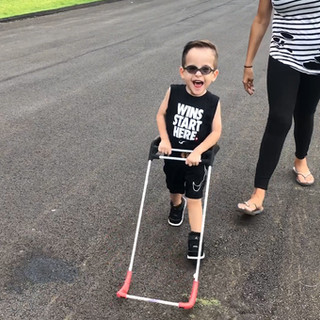
A blind or visually impaired toddler may appear to be walking well because they can move quickly across a familiar room, reach a couch, find a wall, or take an adult’s hand. But speed alone does not tell the whole mobility story.
In our new YouTube video, Greater Expectations: Recognizing and Treating Vision-Impaired Walking Delays, we look closely at Liam’s movement before and while using a Belt Cane. The video asks parents, caregivers, early intervention providers, teachers, and orientation and mobility professionals to look beyond the question, “Can this child walk?” and ask a better one:
Does this child have the information and tools needed to walk safely, independently, and with self-reliance?
Walking Fast to a Support Is Not the Same as Independent Mobility
One of the most important clips in the video shows Liam walking quickly across a living room toward a couch and toy. At first, this can look like proof that he walks well without a mobility tool. He moves fast. He gets where he is going. He reaches the toy.
But when we watch the route instead of the speed, we see something different. Liam is not moving independently through open space. He is traveling to a support.
The couch is not just furniture in the background. It is the destination, the boundary, and the place where Liam receives the touch information he needs to know where he is. Once he reaches the couch, he remains connected to it. That matters.
For toddlers with a mobility visual impairment or blindness (MVI/B), walking to a couch, wall, doorway, shopping cart, or adult hand can hide a walking delay. The child may be moving, but the movement may depend on a predictable object, familiar anchor, or person providing direction, balance, pace, and safety information.
Why Stairs Reveal Missing Information
The video also shows Liam at the top of the stairs. Adults may describe this kind of moment as fear, hesitation, stubbornness, or caution. Fear may be part of what we see, but it is not the whole explanation.
For a child with a mobility visual impairment, hesitation can be a reasonable response to missing information.
Liam cannot visually preview the stair edge, the height of the next step, or the safest route down. His body begins searching for information. His foot tests. His posture changes. He waits. He reaches. He turns toward support.
Instead of asking, “Why won’t he go?” we need to ask, “What information does he need before he can go?”
That small shift changes everything.
What the Belt Cane Adds
The Belt Cane gives Liam tactile information before his body reaches an obstacle, edge, or change in space. It helps provide information about what is ahead, supports balance, and offers protection while he learns to move without constantly needing a hand, wall, couch, or fixed object.
When Liam, age 3 and blind, first wears the Belt Cane, he may appear slower. He may stand still. He may back up. It would be easy to assume the tool is making walking worse.
But stillness can be progress.
For a blind toddler who has relied on touch feedback from walls, furniture, or adults, standing in open space without holding on can be a major developmental change. Liam is beginning to experience balance, space, and self-reliance in a new way.
The tool is not simply making him move. It is giving him information he can learn to use.
Progress Is More Than Speed
Later clips show Liam moving with increasing confidence and less physical guidance. He begins to stop in open space, start again, and travel without needing to immediately find a wall, couch, or helping hand.
That is the progress we want adults to recognize.
Progress is not only faster walking. Progress is safer, more informed, more self-directed movement.
When we compare early clips of Liam moving quickly to support with later clips of him moving through space with the Belt Cane, the difference becomes clearer. The goal is not equipment for its own sake. The goal is self-reliant mobility.
What Parents and Professionals Should Look For
If a blind or visually impaired toddler appears to walk, look more closely. Ask:
Is the child moving through open space, or moving to support?
Does the child need a wall, couch, object, or adult hand to begin moving?
Can the child stop and start again without finding support?
Does the child hesitate at stairs, thresholds, changes in flooring, or open areas?
Does the child use toe testing, reaching, turning sideways, or waiting to gather information?
Is the child being described as “afraid” when the real issue may be missing mobility information?
Has the child had an orientation and mobility evaluation?
Has the child been offered appropriate mobility tools and instruction early enough?
These questions help us see the difference between movement that looks independent and movement that truly is becoming independent.
Greater Expectations Begin With Better Questions
Families are often told to wait and see. But MVI/B toddlers need adults to notice subtle mobility patterns early.
If a blind child walks only to furniture, waits while holding the wall, needs a hand to leave one place and go to another, hesitates at stairs, or seems fearful in open space, the child may not be refusing to walk. The child with an MVI/B may be missing the information needed to walk safely.
Greater expectations begin when we stop asking only, “Can this blind child walk?” and start asking, “Does this child with a mobility visual impairment have the tools, information, and support needed to walk safely and independently?”
Watch the new video on YouTube, share it with families and early intervention teams, and use it to start a better conversation about walking delays, mobility tools, and self-reliant movement for blind toddlers.


Comments