


Pop the Bubble Wrap: Why the Pediatric Belt Cane Makes Summer More Fun for Blind Kids
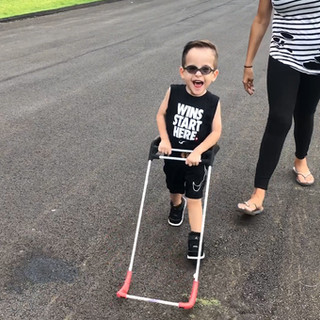
A fun, cheeky guide to why touch-based mobility support helps kids with a mobility visual impairment or blindness (MVI/B) play bigger, move bolder, and pop the bubble wrap on summer.

Summer is not supposed to feel like a safety briefing with snacks. It is supposed to feel like stomping through grass, zigzagging across the yard, charging toward the sprinkler, climbing something questionable, and yelling “again!” with zero interest in anyone’s sensible objections. Blind kids deserve that version of summer too.
And yet, the second a mobility tool appears, some sighted adults suddenly act like the fun police have entered the chat.
But the Pediatric Belt Cane is not bubble wrap. It is much closer to the thing that lets the bubble wrap come off with a dramatic pop.

It gives children with a mobility visual impairment or blindness something incredibly useful: ongoing touch feedback about what is ahead—solid ground, a surface change, a curb, a step up, a step down, or the reassuring message that yes, you can keep moving.
And once you understand that touch is doing the heavy lifting, the whole conversation starts to make a lot more sense.
Why the “Bubble Wrap” Comparison Gets It Backward
When people say, “Take off the bubble wrap,” they usually mean: let kids with an MVI/B move, explore, and be less restricted. Great. We agree.
For MVI/B children, the real bubble wrap is not the Belt Cane. It is the constant chorus of “slow down,” “careful,” “wait,” and “hold on” that can turn every joyful moment into a supervised committee meeting.
The Belt Cane changes the mood. It gives a child advance information through touch, which means less freezing, less second-guessing, and less need for someone to narrate the entire planet from arm’s length.

In other words: if you really want to take off the bubble wrap, start with better touch access.
That is what the Pediatric Belt Cane is doing. Not pampering. Not babying. Informing.
Why Extended Touch Feedback Is Essential
Sighted people rarely notice how much vision is bossing everyone around: open space, curbs, floor changes, people nearby, where to step, when to stop, when to go. For blind children, touch is not a backup plan. Touch is the lead singer.
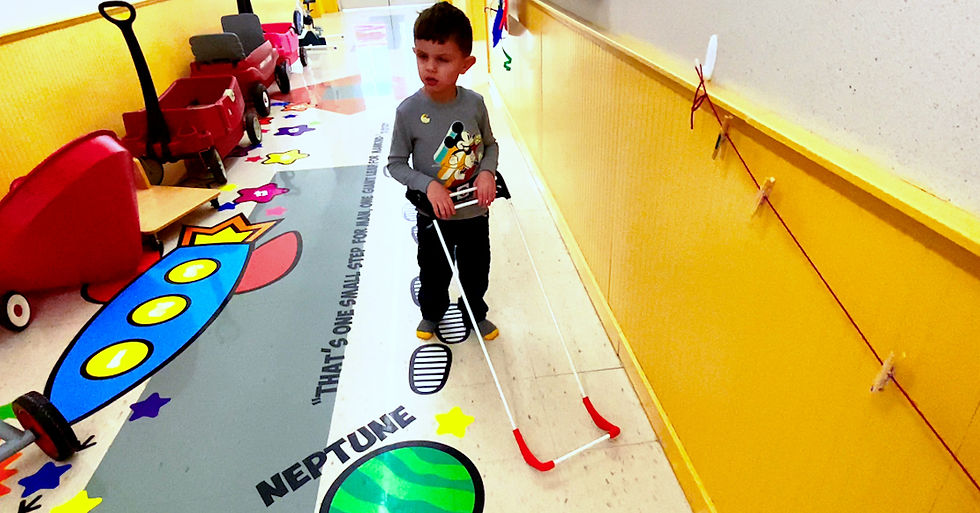
The Pediatric Belt Cane helps by sending information through the cane frame before the child’s body gets there. It can say: solid ground, bumpy floor, curb ahead, step up, step down, obstacle coming, you are good to keep moving.
It can also help with something surprisingly social: personal space. The cane frame bumping into feet prevents kids with an MVI/B getting uncomfortably close to people, the MVI/B child can get information sooner and stay at a more natural distance for talking, joining a group, or moving through a crowd.
And that matters socially as well as physically. The Belt Cane enables children with an MVI/B to approach people at a more natural speaking distance, stay included in group movement, and feel more confident stepping into shared spaces.
Try This This Summer
If the Belt Cane is going to support freedom, let it show up where childhood actually happens: outside, in motion, mid-laugh, mid-sprint, and possibly mid-sprinkler chaos.
Quick ways to make it part of the fun:
Use it during real-life transitions: driveway to grass, sidewalk to playground, path to picnic area.
Pick movement first. Running, turning, stopping, starting, and looping are the point.
Cut back on constant narration. Let touch do some of the talking.
Choose spaces with texture changes, curbs, ramps, edges, and clear boundaries.
Treat it like gear for action, not an apology in accessory form.
Movement Games That Do Not Need Eye-Hand Coordination
Not every great activity has to end with someone catching, throwing, aiming, or visually tracking a tiny object through space. Some of the best summer fun is gloriously full-body and perfectly suited to children who learn through touch, rhythm, motion, and body awareness.
Texture trails: move from grass to mats to rubber surface to gravel and notice every change.
Sprinkler dashes: wet, wild, funny, and very forgiving of imperfect aim.
Dance freeze games: stomp, spin, freeze, repeat.
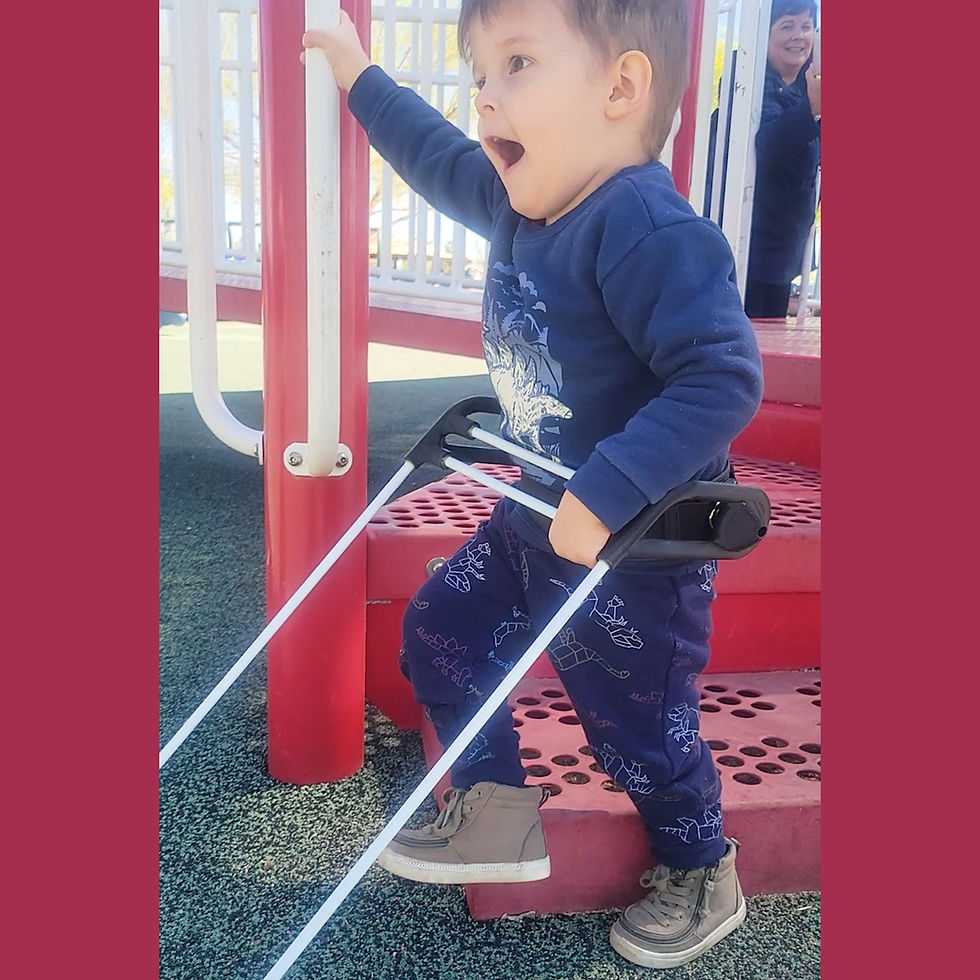
Hill and curb adventures: chances to experience slope, step up, and step down.
Nature route walks: crunchy leaves, wooden bridges, packed dirt, roots, and edges.
Playground loops: cross, climb, turn, descend, repeat like a tiny athlete in training.
Route repeat challenges: do the same path again, then faster, then with one new twist.
This is not watered-down play. It is smart play, skill-building play, confidence-building play, and very often the kind of play that leaves a child grinning and filthy in the best possible way.
What Freedom Looks Like in Real Life
What does that freedom look like? It looks like a child with an MVI/B moving faster because the world is making more sense through touch. It looks like fewer interruptions, more initiative, and more full-body joy.
It looks like a child with an MVI/B crossing the yard, stepping onto the path, finding the curb, weaving around people, and staying in the game instead of being peeled off to the sidelines for “safety.”
And it looks like sighted adults finally getting the memo: touch is not a backup sense here. It is the main event.
We have only just begun to innovate around what touch-based mobility can offer MVI/B children. The answer is not less innovation, less movement, or less freedom. It is more.
This Summer’s Call to Action
So here is the summer takeaway: if you want blind kids to take off the bubble wrap, stop treating touch like a consolation prize and start recognizing it as the lead system for movement.
The Pediatric Belt Cane helps provide the extended touch feedback that makes movement easier to understand, easier to enjoy, and easier to trust.
That means more room to run, more room to explore, more room to join the group, and more room to be gloriously, appropriately, kid-level messy.
The Pediatric Belt Cane is not bubble wrap. It is how the bubble wrap comes off.
Give blind children the extended touch feedback they need, and let them do what summer is made for:
Run. Laugh. Explore. Play hard. Get messy. And discover the world with confidence.

Comments