


The Protected Next Step: How the Belt Cane Builds Self-Reliant Walking in MVI/B Children
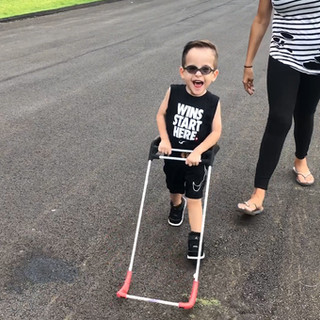
What Protects the Child’s Next Step?
For a sighted child, vision protects the next step. Before the child’s body moves forward, their eyes preview the floor, the chair leg, the hallway, the person walking by, the curb, the toy on the ground, and the space between their body and everything around them.
For a child with a mobility visual impairment or blindness (MVI/B) that visual preview is missing or unreliable. The question is urgent and practical: what protects the space directly in front of the MVI/B child before the child’s body enters it?
The Belt Cane answers that question with a rectangular frame that moves with the MVI/B child. It creates what I call the protected next step: the space in front of the child that must be guarded before the child reaches it.

Phoebe’s Story: From Hand-Holding to Hallway Independence
Phoebe is blind and lives in the United Kingdom. When she was three years old, her family sent a video of her scooting on the floor. At that time, she did not receive a Belt Cane.
By age seven, Phoebe could walk only when holding someone’s hand. If her mother and grandmother sat across from each other, Phoebe might let go, take a step or two, and fall into the other person’s arms. The adults celebrated: “You walked three steps.”
Then Phoebe received the Belt Cane.
Now she is walking the length of her school hallway. She turns the corner and continues independently, even when she is out of sight. She no longer has to hold both hands for balance to cross a street. Instead, she walks solo wearing her Belt Cane while her teacher looks on, teaching her how to listen for cars and decide when it is safe to cross.
That is the power of the protected next step.
What Is a Protected Next Step?
The protected next step is the space immediately in front of the child’s body that needs to be protected before the child moves into it. It is the space where a collision would otherwise happen. It is the space sighted people monitor with vision without having to think about it.
For toddlers, children, and teens with an MVI/B, this space matters every moment they are upright and moving. It matters in a classroom, hallway, playground, kitchen, store, sidewalk, doorway, cafeteria, and crosswalk.
The Belt Cane’s rectangular frame protects that next step by occupying the space in front of the child before the MVI/B child’s body gets there. The frame can meet the chair, table leg, wall, doorway, person, cart, or crowd before the child’s knees, hips, chest, face, or hands do.
This is not a small difference. For an MVI/B child, the importance of protected space cannot be overstated.
Collisions Are Not a Teaching Tool
One harmful misconception is that collisions are simply part of learning to move without sight. Some people assume that when a blind child bumps into a chair, wall, doorway, person, or obstacle, the child is receiving useful orientation information.
But a child’s body should not be the mobility tool.
Repeated body collisions can teach MVI/B children the opposite of independence. They can teach a child to slow down, freeze, reach for an adult, cling to a hand, or stop exploring unless someone else is guiding them. The lesson becomes: moving alone hurts, surprises, embarrasses, or frightens me.
The Belt Cane changes the lesson. It says: you can move forward, and the space ahead of you is being checked before your body enters it. Your hands do not have to be held for every step. Your body does not have to collide to learn. Your mobility tool can protect the next step.
How the Rectangular Frame Works
The Belt Cane is shaped like a rectangle in front of the child. The top of the rectangle connects to the handles. The center horizontal bar can be used to lift the frame or rest hands on it. The bottom of the rectangle runs between two omni wheel rolling tips at either end of the vertical sides.
At the top of each vertical side, the frame curves into plastic handles the child can grip. The child can also grip the carbon fiber vertical rods when they want to manipulate the cane frame.
Because the frame stays in a fixed position in front of the wearer, it can provide about 1.5 feet of personal space from objects and people. That buffer is similar to the visual preview sighted people use automatically to avoid walking into furniture, crowding another person, or entering intimate personal space.

Protected Space Is Personal Space
Most sighted people use vision to stand at the right distance from objects and people. They see the chair before their leg hits it. They see the person in line before stepping too close. They see the hallway traffic before walking into someone’s path.
Blind children and blind adults are too often expected to tolerate accidental intrusion into intimate personal space as something they “cannot help.” Others may step through their path, crowd their bodies, or accept body contact as unavoidable.
The rectangular Belt Cane frame changes that. It gives the wearer a consistent space around the front of the body. It helps the child stand at the correct distance from objects and people. It gives the child information early enough to pause, turn, continue, or adjust without needing body contact first.
Why Early Access Matters for Blind Toddlers and Children with MVI/B
Orientation and mobility is about learning where the body is in space and how to move safely and independently through the environment. Family-facing O&M resources describe these skills as beginning early, including in infancy and toddlerhood, through purposeful movement, body awareness, sensory information, and safe travel experiences.
That matters because blind toddlers should not have to wait until they are older, taller, braver, or better at falling before they are given a way to move safely. Movement is learning. Independent walking is learning. Turning a corner is learning. Crossing a street with instruction is learning.
When a child has no reliable visual preview and no protected next step, adults often become the protection. The child holds hands, leans, waits, or follows. With the Belt Cane, the child can begin receiving information through a tool that moves with them, in front of them, step after step.
FAQ: Belt Cane, Blind Toddlers, and the Protected Next Step
What is a Belt Cane?
A Belt Cane is a wearable mobility tool with a rectangular frame positioned in front of the child’s body. The frame helps detect and guard the space before the child enters it.
What is a protected next step?
A protected next step is the space immediately in front of the child that is checked and guarded before the child’s body moves into it. For sighted children, vision often protects this space. For blind children and children with MVI/B, the Belt Cane can help protect it.
Why is the rectangular frame important?
The rectangular frame is important because it holds a consistent shape in front of the child. It can meet obstacles, objects, and people before the child’s body does, giving the child time and information to respond.
Why are collisions harmful for blind children?
Collisions can teach a child to stop moving, wait for an adult, or rely on hand-holding. They may provide contact information, but they do so after the child’s body has already hit something or someone. The goal should be information before body contact.
How does the Belt Cane support personal space?
The Belt Cane supports personal space by creating a consistent buffer in front of the wearer. This helps the child avoid standing too close to people or objects and gives others a visible cue not to walk through the child’s protected space.
How can families and schools advocate for access?
Families and schools can begin with one question: what is protecting this child’s next step? From there, teams can discuss Belt Cane access, sizing, safe mobility instruction, early intervention, school mobility planning, and funding or donation options.
Ask One Question: What Is Protecting This Child’s Next Step?
Parents, grandparents, TVIs, O&M specialists, early intervention providers, school teams, blindness organizations, donors, and community advocates can all help change what mobility looks like for blind children and children with MVI/B.
Share this post. Ask your child’s team about the Belt Cane. Use the sizing tool. Explore the Blind Baby Safe Mobility Curriculum. Donate so more children can receive Belt Canes. Advocate for access in early intervention and school mobility planning.
Because when we protect the next step, we protect more than movement. We protect confidence, safety, personal space, exploration, and the child’s right to move forward.
Want a printable version for your child’s team? Download the Protected Next Step FAQ handout.

Comments