


What Blind Children Are Really Feeling When You Say “Take That Thing Off Her”: Why Extended Touch Feedback for Blind Children Matters
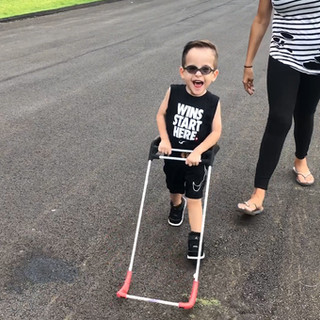
A three-year-old girl climbs on colorful foam stairs at an indoor playscape wearing a Pediatric Belt Cane.
She is not being led.
She is not holding someone’s hand.
She is not waiting for instructions.
She is moving independently.

Each time the Belt Cane frame reaches a soft foam step ahead of her, the extended touch feedback stops her forward motion and prevents her body from colliding with the obstacle. She pauses. Thinks. Adjusts the frame upward. Climbs. Then repeats the process again and again until she reaches the top platform and discovers the slide.
Then she slides down smiling.
Her mother is filming her from 10 feet away. An older boy watches her from close range. He does not rescue her. He does not guide her. He simply watches her problem-solve and succeed on her own.
Most people watching the video celebrated her determination. Some praised the boy for “letting her do it herself.”
But other comments revealed something deeper:
“Just take that thing off her.
“It’s padded — she doesn’t need it.”
“I think it’s too long.”
“It could hurt other kids.”
“Use pool noodles.”
“Instead of helping her, it could cause harm.”
These comments are not really about one child with a mobility visual impairment in a playscape.
They reveal the deep discomfort society seems to have observing children with a mobility visual impairment or blindness use mobility tools.
The Bias Nobody Talks About
Before Safe Toddles' Pediatric Belt Cane, there had never been a mobility tool specifically designed for blind babies or children. Well-known fact, the cane and the dog guide were invented for adults who lost their vision as adults.
For generations before and after the invention of these two mobility tools, parents of children with a mobility visual impairment or blindness have been told some version of:
“Wait until they’re older.”
“One day they’ll use a long cane.”
“They’ll grow into it.”
But that has meant that during the most critical years of development — infancy, toddlerhood, preschool — these children are expected to navigate the world without extended touch feedback designed for their needs.
And that matters.
Because movement is not just transportation. Movement is how children learn:
balance
confidence
spatial awareness
body mapping
orientation
risk assessment
independence
Sighted children receive constant preview information from vision. They see steps before climbing them. They notice walls before colliding with them. They visually anticipate space every second of the day.
Children with a mobility visual impairment or blindness do not.
Without extended touch feedback, they experience the world one collision at a time.
What the Belt Cane Is Actually Doing
Many people watching the video interpreted the Belt Cane’s “push back” as a problem.
But for a child who can't determine the shape, height or length of the foam step visually, that push back is the information.
The moment the frame contacts the foam block, it tells her:
Something is ahead.
Stop moving forward.
Decide what to do next.
That is not dangerous.
That is orientation.
That is mobility.
That is independence.
The bumpiness sighted people dislike is exactly what allows blind children to receive feedback early enough to make decisions before impact.
Without extended touch feedback, there is no warning at all.
The Double Standard
Society accepts mobility equipment for nearly every other disability.
There are:
sports wheelchairs
beach wheelchairs
pediatric wheelchairs
recreation wheelchairs
adaptive strollers
gait trainers
walkers designed for specific environments
Nobody says:
“Take away the wheelchair so the child can become more independent.”
Nobody tells parents:
“Wait until they’re older to have effective mobility tools.”
Nobody argues that mobility support itself is harmful.
Yet children with a mobility visual impairment or blindness are routinely denied the very thing that creates independent movement: reliable environmental preview.
Instead, they are often taught to depend on sighted guides for travel.
At Safe Toddles, we are clear about this:
There is nothing wrong with sighted guide assistance.
The problem begins when sighted guidance becomes a child’s only mobility tool for moving through the world they have.
Because then the child is not receiving independent balance, protection, or environmental information from the environment itself. They are receiving it secondhand from another human being.
Why This Matters Far Beyond Childhood
Many blind adults who excel academically and professionally still travel primarily with sighted assistance.
Not because they lack intelligence.
Not because they lack determination.
But because they spent their earliest developmental years without continuous access to extended touch feedback.
Once congenitally blind children become old enough to explain their experiences, many describe life as constant uncertainty about what lies ahead of the next step.
Sighted people rarely understand what that means emotionally.
So here is a comparison everyone can relate to:
At night, when your house is dark, do you:
A. Turn on the light?
or
B. Stumble through the room hoping you do not hit something?
Sighted people choose “A” automatically because visual preview matters.
Blind children cannot simply turn on vision.
The Pediatric Belt Cane is the first true equivalent of “turning on the lights” through extended touch feedback for children with a mobility visual impairment or blindness.
It gives advance warning.
It gives information before impact.
It gives time to think.
And in that playscape video, you can actually watch a three-year-old child use that information to independently solve a movement problem over and over again.
Not because someone guided her.
Because she could finally feel what was ahead before crashing into it.
That is not dependency.
That is independence.
And it is never too late to begin


Comments