


Building Walkers: A Daily Mobility Framework for Young Blind Children Using the Belt Cane
Updated: May 9
Before First Steps (10–11 Months and Beyond)
From Supported Movement to Intentional Walking
This is a walking plan to help parents and professionals build early walking skills through providing children with a mobility visual impairment or blindness daily recommended hours of meaningful movement every day paired with extended touch feedback.
Who This Stage Is For
MVI/B Children of any age who are not walking independently
May sit, roll, stand with support
Has the physical potential to walk
Needs help initiating and sustaining upright balance
Your Goal in This Phase
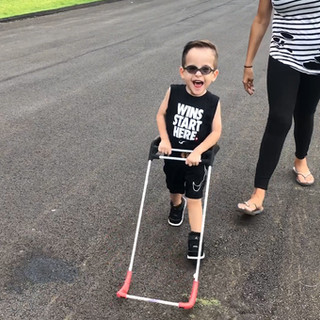
We begin the walking journey through fun activities that allow the child to experience how their body moves and can support itself against gravity with the aid of extended tactile feedback. Children enjoy
transitioning into crawling, seated and upright positions within the boundaries helped defined by the Belt Cane frame
exploring different postures for weight bearing using hands, legs, feet and Belt Cane, and
engaging in early spatial awareness with an appropriate forward social distance from objects and people.

The Daily Target
Aim for 1–2 total hours per day of movement exposure
Not all at once. Not formal sessions.
Think:
5 minutes here
10 minutes there
Repeated all day
Extended touch feedback is woven into movement to replace unreliable vision.
Movement with Touch Feedback in Real Time
MVI/B children wearing the Belt Cane while awake and outside the confines of high chair ensures essential access to extended touch feedback across the day.
Here's how:
1. Diaper Changes = Movement Opportunities
It is a natural need to change diaper the child must transition from upright posture to lying supine (on back). The alert child can be instructed in how to participate in getting into position and changed.
To do this starting around 10 months, your changing space will need room for the cane frame to spread out to its full length.
The child may still rely on parent for full balance support during the transition.
Pair vocabulary words with concrete actions: sit down, lie down, legs up, hold the diaper.
Allow and encourage MVI/B child to stand up from being changed and experience weight-bearing through legs for a few bounces or more.
Play with standing up balance forward, side to side, and back to encourage stepping feet apart to improve standing balance.
Why it matters: repeated daily transitions build strength and teach vital concepts through natural repetition.

Children can learn to hold their diaper, as the adult discusses the temperature, smell, and other concrete sensory experiences along with the motor skills of standing up, sitting down, lifting legs. During this process with a child, the Belt Cane touch sensations are adding stability, information, and reinforcing their sense of personal space.
The child's natural inclination to lift and tap the cane frame is a first way for them to gain autonomy and distance from others.

2. Floor Play → Sit → Stand → Move
Interaction with noise-making objects that can be placed and located all around the child.
Find a way to capture the child's attention and cause a reaction - a laugh, a noise, and expand upon that moment.
Repeat the noise
Repeat the action to try and recreate the baby's reaction.
Wearing the Belt Cane, the child has constant extended touch feedback during activities that encourage them to stand, cruise, find things on top of couches and bring them back to the carpet, picking them back up again.
Allowing games to be the noisy ball falls off the couch, find it, put it back on the couch, and push it off again. Laugh a lot.
Encourage activities that shift weight on hands and knees, feet and hands, feet within the understanding that the Belt Cane extended feedback will compensate for lack of vision.
Why it matters: For a child with an MVI/B, movement with extended touch feedback enforces natural social distance when they are engaging with others. MVI/B play is movement supported by extended touch feedback needed for balance, protection, and information.

3. Supported Standing Exploration
Build a space that welcomes the child's mobility tool. Assist them in figuring out how to be at couch, coffee table, or your body while wearing their Belt Cane.
Let them explore surfaces from all angles and properties - bang with the hand, bang with the cane frame.
This is where something important happens:
The child with an MVI/B experiences “contact before collision.”
That is the foundation of confident independence.
4. Assisted Stepping (Short + Frequent)
Hold at Belt Cane handles or trunk (not just hands)
Stand alone
Take a few steps at a time with support
Stop before fatigue
You’re not building endurance yet—you’re building pattern recognition

Why the Belt Cane Starts Now
At this stage, the Belt Cane is about:
Enjoying early benefits of extended touch feedback
Teaching the body how to best respond to the cane frame
Ensuring child has appropriate social distance for bumping into things
The polygon structure that rolls ahead of the child quietly teaches:
“The world can be explored confidently.”

Simple Daily Rhythm
Morning: 10–15 min movement during dressing + play
Midday: 10 min supported stepping + standing play
Afternoon: 15–20 min upright exploration with Belt Cane
Evening: repeated short bursts during routine care
That’s how you reach 1–2 hours—with fun and routine.
What Comes Next
In the next post, we move into:11–14 months: When your child can take steps with support—and how to turn that into real walking
Closing Thought
Walking for the MVI/B child is not just about legs and arms.
It’s about:
trust
information
repetition
and the right tool in partnership in the journey
Start early. Stay consistent. Keep it part of life.
To learn more about integrating the Belt Cane into an MVI/B child's daily physical activities and obtain ACVREP CEUs go to our curriculum and courses: https://safetoddles.podia.com/
The Blind Baby Safe Mobility curriculum was funded by generous donations Nicholas B. Ottaway Foundation, the Delta Gamma Foundation, and people like you.


Comments