


Preparing Your Child with an MVI/B to Navigate School with Confidence
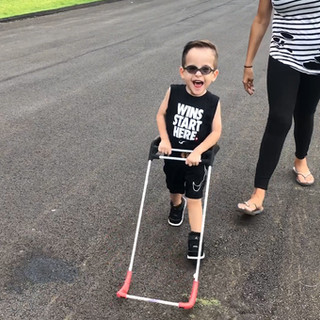
Article 3 in Safe Toddles Pediatric Belt Cane Back-to-School Readiness Series.
Imagine walking into a crowded school cafeteria without being able to see what is ahead of you.
Students are talking, chairs can be suddenly pulled out, backpacks lying on the floor, classmates moving in every direction. In a word, unpredictable.
For a child with a mobility visual impairment or blindness (MVI/B), this is also part of every school day. The Pediatric Belt Cane helps by providing continuous extended touch feedback ahead of the child’s body, allowing the child to discover obstacles, boundaries, and openings through the cane frame before making body contact. Summer gives families time to turn ordinary outings into meaningful school readiness practice.
What Is Extended Touch Feedback?
Sighted children gather information from several feet away with vision. Children with an MVI/B gather information through touch. Before they have an effective mobility tool, that touch may come from hands, feet, knees, shoulders, or faces contacting whatever is in the way.
The Pediatric Belt Cane extends touch several steps ahead of the child’s body. Instead of discovering a chair, doorway, wall, or trash can through a painful collision, the child discovers it through the cane frame. That simple difference changes how movement feels.
The cane frame provides an impenetrable 2-step barrier that enforces personal space, clears the path while allowing the child with an MVI/B to gather information about their surroundings as they move, making unfamiliar environments feel more predictable and less overwhelming.
Extended touch feedback helps children with an MVI/B move through obstacle-filled situations with greater awareness. Continuous tactile information through a full cane arc makes unfamiliar environments feel predictable. Predictability supports confidence, and confidence gives children with an MVI/B the will to move, explore, choose, and participate on their own terms.
School Is Full of Orientation Challenges
School mobility is not only about avoiding obstacles. It is about knowing where you are, where you are going, what is around you, and how to keep moving when the environment changes.
Children at school will constantly need to:
find classroom doors
locate lockers
identify their desk
navigate the cafeteria
find friends
navigate the restroom
navigate playgrounds
follow hallways
recognize intersections
locate buses
Every one of these tasks becomes easier when children with an MVI/B continuously receive tactile information while walking.
Practice This Summer: Turn Everyday Places into fun Mobility Lessons
Restaurant Challenge
Restaurants are excellent school readiness practice because they require children to move through changing pathways, detect chairs and tables, find family members, listen for directions, and communicate with unfamiliar adults.
Locate the entrance.
Walk between tables and chairs.
Detect furniture by bumping into it with cane frame.
Locate and confirm the family’s table. Ask, "Is this our table?"
Pull out a chair and sit down safely.
Maintain comfortable personal space.
Speak with the host or server.
Order food or ask a question.
This is also excellent self-advocacy practice. A child can learn to ask, “Excuse me, is there a wider aisle to get to our table?” or “Could you tell me where the table is after I pass the drink station?” Families are often surprised by how quickly children begin asking these questions independently.
Food Court Challenge
Food courts are very similar to school cafeterias. They are noisy, crowded, unpredictable, and full of chairs, tables, lines, trays, trash cans, and moving people.
Carry a tray or small bag while walking.
Move around chairs and tables.
Listen for family voices.
Choose the easiest pathway.
Look for wider aisles.
Find an empty table, ask "excuse me, is anyone sitting here?".
Wait in line.
Carry trash away from the table to dispose of appropriately.
These become school skills. A child who practices moving through a food court in July is better prepared to enter the cafeteria in September.
Library Challenge
Libraries help children practice quiet indoor travel, listening, locating familiar places, and using landmarks. Practice finding the checkout desk, children’s section, reading corner, elevator, restroom, and exit.
Introduce landmarks in natural language: “The elevator is beside the large window,” or “The children’s books are past the information desk.” Children begin understanding orientation when adults describe places in ways other people can recognize too.
Grocery Store Challenge
Grocery stores offer long straight aisles, changing displays, carts, people, sounds, smells, and opportunities to ask for help. They are ideal for practicing school hallway travel and problem solving.
Find aisle openings.
Locate items on the shopping list using recognition technology
Follow long straight paths.
Move around displays.
Use clues such as bakery smells or refrigerator sounds.
Use voiceover to access orientation and other support apps, (e.g., Be My Eyes)
Ask an employee for help.
Return to a familiar location, such as the checkout area.
Build Orientation Skills Alongside Belt Cane Use
Extended touch feedback helps children discover what is immediately around them. Orientation teaches children how those discoveries fit together.
During summer practice, families can help children notice landmarks, clues, and directions.
Landmarks
Landmarks are things that stay in the same place, such as a drinking fountain, large tree, staircase, principal’s office, playground gate, or library entrance.
Clues
Clues are pieces of information that may change but still help a child understand where they are. Examples include children talking, lunch smells, music from PE, an echoing hallway, running water, or the sound of a bus engine.
Directions
Even young children can begin learning directional language such as left, right, straight, stop, turn around, toward, away from, before, and after. Older children can also begin using north, south, east, and west when appropriate.
Practice Wayfinding Technology
Summer is also a good time to introduce accessible navigation technology in low-pressure ways. Technology should support, not replace, strong orientation skills.
While riding in the car or walking familiar short routes, families can use accessible map or navigation tools with screen reader support and ask simple questions: “What street are we on?” “What landmark did the phone announce?” “How far until the next turn?” “Are we getting closer or farther away?”
Confidence Comes From Experience
Confidence is not taught in a single lesson. Confidence is earned through repeated successful experiences.
Every restaurant, grocery store, playground, library, sidewalk, and neighborhood walk gives a child another chance to think, “I can figure this out.”
Prepare for a Full School Day
School is different from a short therapy session or a quick outing because children may wear the Belt Cane for long stretches of the day. Endurance matters.
During summer, gradually practice longer periods of wearing, walking, playing, eating lunch, shopping, visiting friends, attending community events, or participating in family routines while using the Belt Cane.
The goal is not simply tolerating the Belt Cane. The goal is for the Belt Cane to become a natural part of exploring, playing, learning, and traveling through the day.
Conclusion
Every summer outing can become an investment in school success. Every obstacle discovered through extended touch feedback becomes another lesson in confidence. Every conversation with a restaurant host becomes self-advocacy. Every food court becomes a cafeteria. Every library becomes a school hallway.
By the first day of school, your child is not simply wearing a Pediatric Belt Cane. They are bringing an entire summer of practice, orientation, exploration, endurance, and independence with them.
Belt Cane Back to School Guide: Five-part Series
Links
Article 3: Why Extended Touch Feedback Matters at School (current article)
Article 4: From Classroom to Playground: Helping Blind Students Keep Up
Article 5: Writing Better IEP Mobility Goals for Independent School Travel


Comments