


Every Blind Child Deserves Independence
Every Blind Child Deserves Extended Touch-Fueled Independence
What does independence look like for a two-year-old? For young children, independence is not about voting, driving, or making big life decisions. It is much simpler. Independence is walking across the room to get a favorite toy.
It is following a parent into the kitchen.
It is chasing a friend down a hallway.
It is exploring the world one step at a time.
As we approach Independence Day, Safe Toddles is celebrating a different kind of freedom: the freedom to move.
This is Wesley's story.
Meet Wesley
Wesley is two years old and blind due to optic nerve atrophy. Like many toddlers his age, Wesley loves people, voices, movement, and exploration.
Unlike most toddlers, Wesley must navigate a world without vision.
Wesley can walk. His family described his walking as completely independent. But what his parents did not yet understand, walking independently and moving efficiently through the world are not always the same thing.
Without a mobility tool, Wesley's parents described his walking as "in circles, bumping into walls and furniture, flapping his hands, and moving back and forth within familiar spaces". Like all young children born blind, he only learned about what was ahead of him once he stepped on it.
His family wanted something more. We want a Pediatric Belt Cane, they said,
"So he can walk around without bumping into things."
Their goal was simple. They wanted Wesley to have more predictable access to the world around him.
Then Something Changed
When Wesley first put on his Belt Cane, the response was immediate.
His family later described him as being "like a rocket ship."
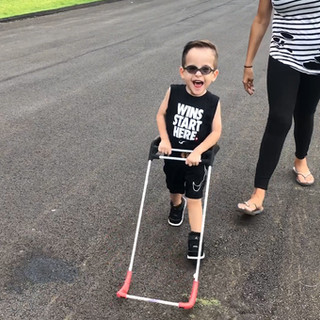
Instead of repeatedly encountering walls and furniture with his body, his cane frame took the hit. With that simple change, he had the information he needed to walk quickly without having to sacrifice his safety.
Instead of staying within small familiar spaces, the cane frame gave him the information he needed to explore farther.
Instead of moving in safe circles, he started traveling in straighter lines towards the unknown.
Instead of waiting for someone to bring the world to him, he moved toward the world.
Toward people.
Toward voices.
Toward activity.
Toward adventure.
Information Changes Movement
Most people allow that blindness disrupts visual motivation to walk, but are taught to view the bumps and collisions as a necessary part of blind walking skills. When a blind child can physically walk into a wall with his body, the assumption is that mobility is solved.
But movement is about more than putting one foot in front of the other.
Movement requires advanced information.

Movement requires advanced information.
Sighted toddlers constantly receive visual information about where objects, people, pathways, and destinations are located. This allows them to think about their next step, chose a direction, and their pace.
Blindness robs the child of visual preview, unless blind and mobility visually impaired learners are provided extended touch preview for their advanced information.
The Pediatric Belt Cane provides blind children with continuous, extended touch feedback while they move. For Wesley, the difference was visible.
Not because he learned how to walk.
Because he gained information that improved his walking. He walked faster, was pro-active, and engaged.
Chasing Possibilities
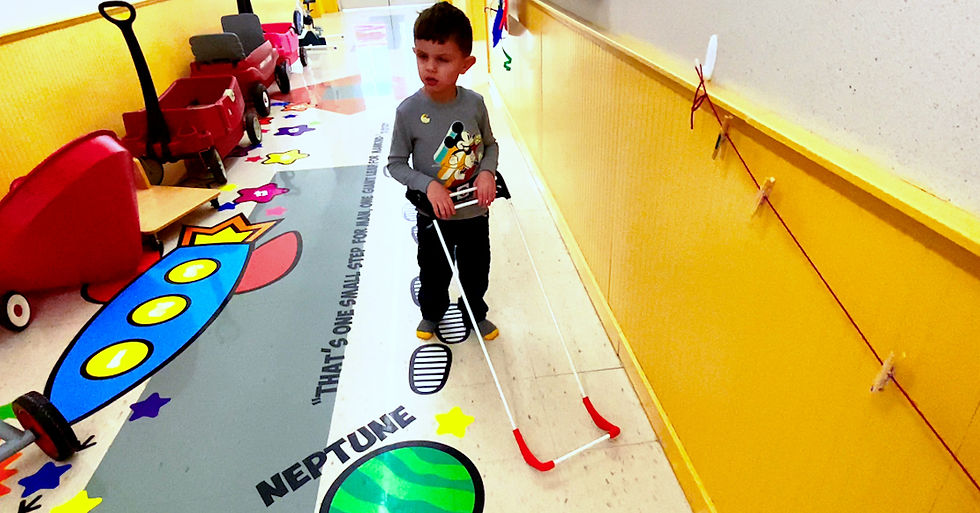
One of our favorite videos shows Wesley moving quickly down a hallway while calling out to his teacher:
"I'm going to get you!"
It is a joyful moment.
A playful moment.
A completely ordinary toddler moment that contrasts with the first moment in the video when he was still without a mobility tool, the teacher prompts him to
"Get the toy, Wesley".
And that is exactly why it matters.
Through extended touch feedback blind and mobility visually impaired children are able to chase the people they love.
They are able to explore hallways, playgrounds, parks, and backyards.
They are able to discover what is around the next corner.
For a child with a mobility visual impairment or blindness, access to those experiences begin with access to mobility information.
Every Blind Child Deserves Daily Independence
When most people think about independence, they think about freedom.
At Safe Toddles, we think about freedom too.
The freedom to move.
The freedom to explore.
The freedom to participate.
The freedom to be a blind child with a bold white cane frame extended out ahead -- extended long, wide ahead.
Wesley's story reminds us that independence does not begin at age eighteen.
It begins with a toddler having the tools he needs to take confident steps toward the world around him.
This Independence Day season, we celebrate children like Wesley who have the technology they need to discover new opportunities to move, learn, play, and grow.
Because every blind child deserves their own Independence Day.
Help More Children Move Toward Independence
Safe Toddles provides Pediatric Belt Canes and mobility support to young children with a mobility visual impairment or blindness.
Your support helps children with a visual impairment gain access to movement, exploration, and participation during the years when development matters most.
Together, we can help more children with blindness discover what is waiting around the next corner.


Comments