


🚨 ALERT! The Definition of an AMD Has Changed
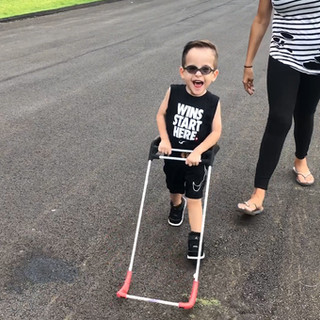
And if you work with blind babies and toddlers, you need to know what this means.
There is something buried in the newest edition of Foundations of Orientation and Mobility that parents of blind children—and the professionals serving them—should pay attention to.
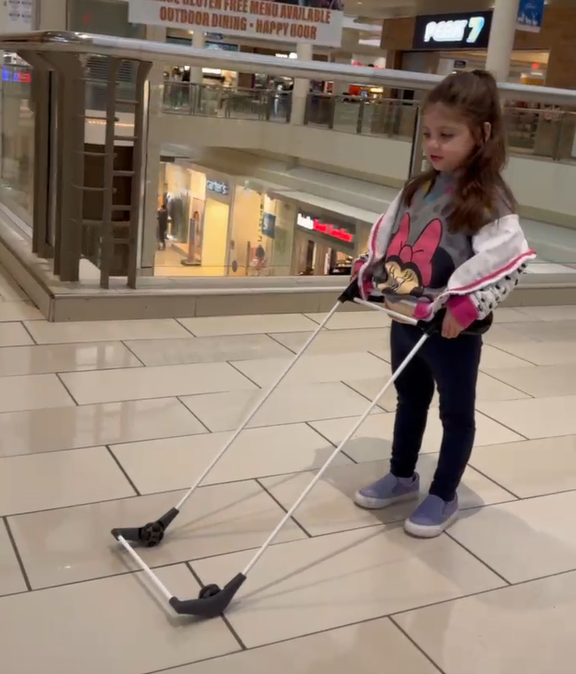
The 4th edition of Foundations of Orientation and Mobility, published in 2024, is presented as a major professional reference for O&M students and practitioners. It includes a dedicated chapter on O&M services during the early childhood years.
And the definition of an adaptive mobility device (AMD) matters.

Because if an AMD is a mobility tool for someone who is “incapable of mastering the techniques of the long cane” to preview the path ahead, we need to stop and ask a very basic question:
Who exactly are we talking about?
A 10-month-old blind baby?
A 15-month-old toddler?
A 2-year-old who is just beginning to explore the world independently?
A preschooler who has not yet developed the motor pattern required for a conventional long-cane technique?
Or the blind child who has been walking for years but still does not consistently swing the long cane from side to side with each step?
If the answer is yes, then something important has changed.
These children are not waiting to become “good enough” long-cane users before they deserve a mobility tool.
They are the children for whom an appropriately designed AMD may make sense.
🚨 Parents: Please read this carefully.
For decades, parents of blind babies and toddlers have heard some version of:
When he drops it means he just feels fine without it.
He'll let you know when he's ready.
And meanwhile, you find as your child gets older they are being carried, guided, physically directed, by an adult. Walking with a blind child is a full-time job for the adult responsible.
That is not the same thing as independent mobility.
A child can be physically capable of walking and still lack an effective way to discover what is in front of them.
That is the problem mobility technology is supposed to solve.

What if the problem isn't the child?
This is where the definition of an AMD becomes interesting.
If the long cane requires a particular developmental and motor skill set to be used effectively, then a young child who has not yet acquired those skills should not automatically be interpreted as a child who simply needs more long-cane instruction.
The problem is not motivation.
It is not compliance.
and it is not that the child needs more time "to learn the technique."
The problem is the tool does not match the child.
And that distinction matters enormously during the first years of life.
A 10-month-old with an MVI/B does not need to be taught to imitate an adult's cane technique before being allowed to explore independently.
A toddler with an MVI/B does not need to master a mature two-point touch technique before receiving information about the environment.
A preschooler with an MVI/B should not have to spend years struggling with a tool that does not match their developmental abilities simply because the profession has decided that the long cane is the default technology.
And here's the part that should make us uncomfortable.
If the professional definition now recognizes an AMD for people who cannot master long-cane techniques, why are we still treating alternative mobility devices as something extraordinary for young blind children?
Why isn't the question:
What mobility tool gives THIS child the best opportunity to move safely, explore independently, and learn from their environment?
Instead, the question too often becomes:
How can we get this child to use the long cane?
Those are not the same question.
But there is another problem: homemade does not mean effective.
This is where we need to be honest.
Once we acknowledge that some children need an alternative mobility device, we cannot simply tell parents or professionals:
“Build something.”
A PVC contraption crafted from parts purchased at the hardware store is the definition of an AMD.

Yet, a device that looks like it provides a preview of the path is not necessarily providing the child with an MVI/B the information, coverage, maneuverability, stability, and developmental access they need, because they are also incapable of performing skills needed for path preview.
The device matters.
Its dimensions matter.
Its fit matters.
Its weight matters.
Its contact with the environment matters.
Its ability to move with the child matters.
And most importantly, what the child can actually learn and do with it matters.
That is why we developed the Pediatric Belt Cane.
It was designed around a different developmental starting point.
The child just has to be blind or mobility visually impaired.
The device is worn at the child's waist, allowing the mobility system to move with the child while providing a protective preview of the path.
That is a fundamentally different approach to early mobility.
The question has been dropped, now it is an urgent recommendation.
We should no longer be limited by the option handheld cane or nothing leading us to ask:
“Does this child with an MVI/B have the walking and other motor skills to use a long cane?”
We should be asking:
“Does this child have blindness or a mobility visual impairment. Yes? - How soon can we get a mobility tool for them?
And if the answer is an AMD, then let's provide an effective, appropriately designed, properly fitted mobility device—that can be used most of the day.
Because childhood is not a waiting room for independence.
Mobility skills are learned by moving. The MVI/B child needs to move behind the protective frame to learn how to rely upon and respond to extended touch feedback.
And children with an MVI/B deserve the opportunity to move with extended touch feedback leading the way "path preview" is a fancy way of saying touching the ground ahead to make sure its sound and ready for me to take a step or not.
A message for TVIs and O&M specialists
If you work with an MVI/B infant, toddler, preschooler, or child recognize their struggle with conventional long-cane technique as the moment to reconsider the question.
Don't ask only:
“If I keep trying day after day, will this child with an MVI/B master the long cane one day?”
Ask:
“Is the child with an MVI/B currently "incapable of learning long cane techniques for path preview?”
If the answer is yes, the child with an MVI/B doesn't need another year of waiting.
The childwith an MVI/B needs another tool.
Source: Emerson, R. W., Blasch, B. B., & Wiener, W. R. (Eds.). (2024). Foundations of Orientation and Mobility, 4th ed. APH Press.


Comments